AIIMS M.Sc Nursing Entrance 2026 question paper
AIIMS M.Sc Nursing Entrance · 2026 · 90 questions · 90 minutes · 0.33 mark deducted per wrong answer
- Medical & Surgical Nursing 30
- Obstetrics & Gynaecology 11
- Child Health Nursing (Pediatrics) 11
- Mental Health Nursing 8
- Community Health Nursing 8
- Nursing Management & Leadership 4
- Pharmacology 4
- Nursing Research & Statistics 4
- Applied Psychology 3
- Nursing Education 3
- Nursing Foundations 2
- Applied Microbiology & Infection control 1
- Applied Physiology 1
See the answers and explanations
Sign in free: every answer with its explanation, attempt the paper timed with negative marking, and track your score.
Q1 · Mental Health Nursing · Personality and Sexual Disorders
A young woman presents with a history of emotional instability, dependent behavior, impulsive aggression, and unstable interpersonal relationships. Which of the following is the most likely diagnosis?
- A.
Dependent personality disorder
- B.
Antisocial personality disorder
- C.
Histrionic personality disorder
- D.
Borderline personality disorder
- A.
Q2 · Applied Psychology · Cognitive Process
child with an IQ of 55 is classified as having?
- A.
Severe intellectual disability
- B.
Moderate intellectual disability
- C.
Profound intellectual disability
- D.
Mild intellectual disability
- A.
Q3 · Nursing Management & Leadership · Management Process
Which of the following refers to a statement of minimum qualifications, skills, and abilities required for a job?
- A.
Job analysis
- B.
Job report
- C.
Job description
- D.
Job specification
- A.
Q4 · Obstetrics & Gynaecology · Hypertensive Disorders in Pregnancy
Which of the following laboratory findings in HELLP syndrome requires immediate reporting?
- A.
AST < 35 IU/L
- B.
Hemoglobin 11 g/dL
- C.
Creatinine 0.8 mg/dL
- D.
Platelet count 45,000/mm³
- A.
Q5 · Pharmacology · Miscellaneous
Methadone in case of opioid treatment is used during which phase?
- A.
Maintenance therapy
- B.
Withdrawal therapy
- C.
Overdose
- D.
Toxicity
- A.
Q6 · Medical & Surgical Nursing · Musculoskeletal Function
Which of the following structures are commonly affected in Paget disease?
- A.
Short bones of the hand
- B.
Axial skeleton
- C.
Facial bones
- D.
Appendicular skeleton
- A.
Q7 · Medical & Surgical Nursing · Metabolic and Endocrine Function
The earliest sign of diabetic nephropathy is?
- A.
Hypertension
- B.
Edema
- C.
Microalbuminuria
- D.
Fat in urine
- A.
Q8 · Medical & Surgical Nursing · Oncology: Nursing Management in Cancer Care
A patient with Superior Vena Cava (SVC) syndrome develops several symptoms. Which of the following requires immediate nursing attention?
- A.
Facial edema
- B.
Headache that worsens on bending forward
- C.
Dilated neck veins
- D.
Dyspnea at rest
- A.
Q9 · Nursing Education · Assessment and Evaluation Methodologies
A teacher asks a student to explain the pathophysiology of respiratory failure in his own words. Which level of learning is being assessed?
- A.
Knowledge
- B.
Comprehension
- C.
Evaluation
- D.
Application
- A.
Q10 · Medical & Surgical Nursing · Cardiovascular, Circulatory, and Hematologic Function
Which of the following is an indication for IABP (intra-aortic balloon pump)?
- A.
Septic shock
- B.
Cardiogenic shock
- C.
Pericarditis
- D.
Pulmonary embolism
- A.
Q11 · Nursing Management & Leadership · Professional Advancement
hospital union meets with management to discuss salary increase and working hours. This situation represents?
- A.
Recruitment process
- B.
Collective bargaining
- C.
Performance appraisal
- D.
Disciplinary action
- A.
Q12 · Child Health Nursing (Pediatrics) · Newborn Infants
A newborn delivered by cesarean section develops tachypnea (respiratory rate >70/min), nasal flaring, and mild intercostal retractions shortly after birth. What is the most appropriate initial management?
- A.
Start chest compressions and positive pressure ventilation (PPV)
- B.
Shift the newborn to the NICU for immediate mechanical ventilation
- C.
Observe closely and provide supportive care
- D.
Initiate skin-to-skin contact with the mother and inform the physician
- A.
Q13 · Nursing Research & Statistics · Research Approaches and Designs
Rare side effects following immunization are best studied using which type of study?
- A.
Cross-sectional study
- B.
Ecological study
- C.
Case-control study
- D.
Cohort study
- A.
Q14 · Medical & Surgical Nursing · Musculoskeletal Function
patient complains of tingling and pain in the thumb, index finger, and middle finger, which worsens during the day and improves with rest/sleep. Which condition is most likely?
- A.
Ulnar neuropathy
- B.
Cervical radiculopathy
- C.
Peripheral neuropathy
- D.
Carpal tunnel syndrome
- A.
Q15 · Obstetrics & Gynaecology · Special Topics in Obstetrics
A 19-year-old develops acute kidney injury (AKI) following a road traffic accident (RTA). Which of the following is the most likely cause?
- A.
Postrenal
- B.
Intrarenal
- C.
Prerenal
- D.
Intrinsic renal
- A.
Q16 · Obstetrics & Gynaecology · Term Newborn Infant
mother asks a nurse, "How would I know that my baby has fed well?" The most appropriate answer by the nurse would be?
- A.
The baby will not cry after feeding.
- B.
The baby will pass urine and soil 6–8 diapers per day.
- C.
You will feel emptiness in your breasts.
- D.
The baby will sleep for 4 hours between feeds.
- A.
Q17 · Applied Microbiology & Infection control · Immunity
Which type of immunity is transferred from the mother to the fetus through the placenta?
- A.
Innate immunity
- B.
Active natural immunity
- C.
Passive natural immunity
- D.
Acquired immunity
- A.
Q18 · Community Health Nursing · Epidemiology – Epidemiological Approaches and Processes
An epidemic characterized by person-to-person transmission is known as?
- A.
Common source epidemic
- B.
Point source epidemic
- C.
Propagated epidemic
- D.
Sporadic epidemic
- A.
Q19 · Medical & Surgical Nursing · Oncology: Nursing Management in Cancer Care
A client with leukemia develops hyperphosphatemia, hyperkalemia, hypocalcemia, and hyperuricemia. Which of the following is the most appropriate initial intervention?
- A.
Restrict oral fluids
- B.
Aggressive IV hydration therapy
- C.
IV calcium gluconate
- D.
Oral potassium supplemen
- A.
Q20 · Medical & Surgical Nursing · Neurologic Function
patient has sustained a C5 spinal cord injury. Which of the following is the most immediate life-threatening complication?
- A.
Autonomic dysreflexia
- B.
Respiratory failure
- C.
Neurogenic shock
- D.
Plantar flexion deformity
- A.
Q21 · Child Health Nursing (Pediatrics) · Common Medical Procedures
pediatric patient is prescribed 300 mL normal saline (NS) to be infused over 6 hours using a pediatric drip set. What is the correct flow rate?
- A.
40 mL/min
- B.
70 mL/min
- C.
50 mL/min
- D.
60 mL/min
- A.
Q22 · Medical & Surgical Nursing · Gas Exchange and Respiratory Function
A client develops sudden hypotension, tachycardia, tracheal deviation to one side, and diminished breath sounds. The client is most likely a case of?
- A.
Cardiac tamponade
- B.
Pulmonary edema
- C.
Tension pneumothorax
- D.
Heart failure
- A.
Q23 · Child Health Nursing (Pediatrics) · Newborn Infants
36-week preterm baby has mild desaturation during deep sleep but no serious complications. Which of the following is the most appropriate sleeping position?
- A.
Prone position to decrease desaturation episodes
- B.
Any position that facilitates breathing and prevents rolling
- C.
Supine on a firm surface
- D.
Sleep along with parents to monitor for any event
- A.
Q24 · Medical & Surgical Nursing · Cardiovascular, Circulatory, and Hematologic Function
A patient with an Implantable Cardioverter-Defibrillator (ICD) reports experiencing multiple shock episodes while at home. He is now in the emergency department, fully conscious, oriented, but anxious. What is the next best step?
- A.
Reassure the patient that this is a normal occurrence.
- B.
Immediately deactivate the ICD.
- C.
Attach the patient to an ECG monitor and assess vital signs.
- D.
Administer a sedative and discharge the patient if symptoms improve
- A.
Q25 · Medical & Surgical Nursing · Cardiovascular, Circulatory, and Hematologic Function
A 56-year-old patient underwent PCI for STEMI involving the LAD artery and was started on dual antiplatelet therapy (DAPT). What is the most appropriate teaching regarding this therapy?
- A.
Stop the medicines if you notice mild bruising.
- B.
Discontinue the medicines once you feel better.
- C.
Take both medicines exactly as prescribed.
- D.
Take a double dose if you miss a dose.
- A.
- Sign in free
Done 25 questions? Check your answers
Sign in free: every answer with its explanation, attempt the paper timed with negative marking, and track your score.
Q26 · Mental Health Nursing · Principles and Concepts of Mental Health Nursing
A client says, "I know this is wrong, but I can't control myself." This statement is an example of?
- A.
Ego-syntonic behavior
- B.
Denial
- C.
Projection
- D.
Ego-dystonic behavior
- A.
Q27 · Obstetrics & Gynaecology · Complications of the Third Stage of Labor
A postpartum woman has a boggy uterus that is deviated to the right side. Which of the following is the most likely cause?
- A.
Retained placenta
- B.
Bladder distension
- C.
Cervical laceration
- D.
Uterine atony
- A.
Q28 · Community Health Nursing · Epidemiology – Epidemiological Approaches and Processes
What does the term"reverse cold chain” describe?
- A.
Measles sputum transport
- B.
Vitamin A supplementation
- C.
Transport of food samples
- D.
Polio vaccine transport
- A.
Q29 · Mental Health Nursing · Schizophrenia
A person reports hearing voices that do not exist, disorganized thinking, emotional disturbance, and abnormal behavior for the past 6 months. According to DSM classification, this most likely falls under which category?
- A.
Mood disorders
- B.
Anxiety disorders
- C.
Personality disorders
- D.
Schizophrenia spectrum and psychotic disorders
- A.
Q30 · Child Health Nursing (Pediatrics) · Newborn Infants
On the 3rd day of life, a term newborn has lost 11% of the birth weight, usually sleeps during feeding, wets fewer than 4 diapers/day, and the mother complains of sore nipples. What is the most appropriate advice?
- A.
Advise the mother to stop breastfeeding and start formula feeding
- B.
Reassure the mother that the weight loss is normal
- C.
Observe feeding technique, assess latching, provide lactation support, and introduce supplementary feeds if indicated
- D.
The baby sleeps every 4 hours in between feeding
- A.
Q31 · Medical & Surgical Nursing · Metabolic and Endocrine Function
Somogyi effect refers to?
- A.
Dawn phenomenon causing early morning hyperglycemia
- B.
Persistent hyperglycemia due to insulin deficiency
- C.
Nocturnal hypoglycemia followed by rebound morning hyperglycemia
- D.
Local allergic reaction at insulin injection site
- A.
Q32 · Medical & Surgical Nursing · End-of-Life Care
Primary trauma care follows?
- A.
ACBE
- B.
ABCDE
- C.
ABCD
- D.
ACB
- A.
Q33 · Medical & Surgical Nursing · Sensorineural Function
client with Graves' disease complains of eye pain and visual disturbances. Which of the following complications is most likely?
- A.
Glaucoma
- B.
Optic nerve pressure
- C.
Visual disturbanc
- D.
Retinopathy
- A.
Q34 · Medical & Surgical Nursing · Immunologic Function
A client in the Emergency Department comes with hypo tension, facial swelling, and urticaria. Which of the following is the best initial management for this client?
- A.
IV hydrocortisone
- B.
Give IV fluids
- C.
Oral antihistamine
- D.
IM adrenaline
- A.
Q35 · Applied Psychology · Cognitive Process
Exposure and Response Prevention (ERP) therapy is primarily based on which behavioral learning principle?
- A.
Operant conditioning
- B.
Punishment
- C.
Classical conditioning
- D.
Psychoanalytic theory
- A.
Q36 · Medical & Surgical Nursing · Fluid and Electrolytes: Balance and Distribution
Which acid-base disorder is expected in a patient with prolonged vomiting.?
- A.
Metabolic acidosis
- B.
Metabolic alkalosis
- C.
Respiratory acidosis
- D.
Respiratory alkalosis
- A.
Q37 · Child Health Nursing (Pediatrics) · Orthopedic disorders
A child sustains a long bone fracture. An X-ray shows that the cortex is fractured on one side, while the opposite cortex remains intact. Which type of fracture is this?
- A.
Transverse fracture
- B.
Spiral fracture
- C.
Greenstick fracture
- D.
Oblique fracture
- A.
Q38 · Medical & Surgical Nursing · Immunologic Function
Which of the following is the earliest clinical sign of acute graft-versus-host disease (GVHD)
- A.
Hypertension
- B.
Anorexia
- C.
Hypertension
- D.
Acute diarrhea
- A.
Q39 · Medical & Surgical Nursing · Musculoskeletal Function
On examination, a patient is found to have symmetrical, non-tender swelling with bilateral involvement of DIP joints.Rheumatoid factor is negative. What is the most likely associated condition?
- A.
Synovial inflammation
- B.
Rheumatoid nodules
- C.
Uric acid crystal deposition
- D.
Osteophyte formation
- A.
Q40 · Pharmacology · Hormones & Related Drugs
A patient taking levothyroxine complains of palpitations, insomnia, and nervousness. These symptoms are most likely caused by?
- A.
Expected adverse effects of the medication
- B.
Under-replacement of thyroid hormone
- C.
Allergic reaction to levothyroxine
- D.
Over-replacement of thyroid hormone
- A.
Q41 · Pharmacology · Drugs Acting on Central Nervous System
A client with schizophrenia is receiving two antipsychotic medications in the correct dose and frequency, but the symptoms are still not controlled. Which of the following drugs is most effective for refractory schizophrenia and requires blood monitoring?
- A.
Clozapine
- B.
Olanzapine
- C.
Haloperidol
- D.
Quetiapine
- A.
Q42 · Child Health Nursing (Pediatrics) · Newborn Infants
In a tribal community, 95% of deliveries occur in healthcare institutions, yet the infant mortality rate (IMR) remains high within the first 48 hours of life due to birth asphyxia. Which intervention should be prioritized?
- A.
Increase the number of postnatal home visits by ASHAs
- B.
Increase Janani Shishu Suraksha Karyakram (JSSK) incentives
- C.
Strengthen neonatal resuscitation training and ensure skilled birth attendance
- D.
Improve referral transport services for pregnant women
- A.
Q43 · Medical & Surgical Nursing · Musculoskeletal Function
A patient develops tachypnea, petechial rash, and shortness of breath after sustaining a long bone fracture. Which of the following is the most likely diagnosis?
- A.
Disseminated intravascular coagulation (DIC)
- B.
Pulmonary embolism
- C.
Pneumothorax
- D.
Fat embolism syndrome
- A.
Q44 · Community Health Nursing · Epidemiology – Epidemiological Approaches and Processes
In a village, there are sudden deaths of 3 mothers within one month. What is the most important initial step for the community health nurse?
- A.
Conduct health awareness campaign
- B.
Immediately refer all high-risk females
- C.
Provide iron supplementation to all pregnant women
- D.
Review maternal death reports and initiate investigation
- A.
Q45 · Nursing Management & Leadership · Management of Nursing Service in the Hospital & Community
SWOT analysis means?
- A.
Strengths, Weaknesses, Opportunities, and Threats
- B.
Skills, Welfare, Observation, and Techniques
- C.
Strategies, Workforce, Observation, and Trends
- D.
Strengths, Weaknesses, Observation, and Threats
- A.
Q46 · Obstetrics & Gynaecology · Preterm Labor, Preterm Rupture of the Membranes, Postmaturity, Intrauterine Fetal Death
A mother has been given terbutaline for preterm labour. Which of the following should be monitored?
- A.
Bradycardia
- B.
Hyperglycemia
- C.
Hyporeflexia
- D.
Tachycardia
- A.
Q47 · Medical & Surgical Nursing · Musculoskeletal Function
Which of the following is the diagnostic test for osteoporosis?
- A.
Serum calcium levels
- B.
Dual-energy X-ray absorptiometry (DEXA) scan
- C.
X-ray of long bone
- D.
Bone biopsy
- A.
Q48 · Medical & Surgical Nursing · Neurologic Function
During physical examination, a patient experiences pain and resistance on extension of the knee while the hip is flexed This finding is positive for which of the following signs?
- A.
Brudzinski's sign
- B.
Babinski's sign
- C.
Kernig's sign
- D.
Romberg's sign
- A.
Q49 · Mental Health Nursing · Community Mental Health Nursing
The primary objective of the District Mental Health Programme (DMHP) is to?
- A.
Improve medical research in mental health at the national level
- B.
Increase advanced mental health services only at tertiary care centers
- C.
Integrate and improve mental health services at the primary healthcare level,especially in rural and underserved areas
- D.
Establish exclusive psychiatric hospitals in every district
- A.
Q50 · Medical & Surgical Nursing · Metabolic and Endocrine Function
Which of the following is a classical clinical feature of myxedema coma?
- A.
Tachycardia and hypertension
- B.
Hypothermia and bradycardia
- C.
Hyperthermia and tachypnea
- D.
Hypertension and tachycardia
- A.
- Sign in free
Done 50 questions? Check your answers
Sign in free: every answer with its explanation, attempt the paper timed with negative marking, and track your score.
Q51 · Child Health Nursing (Pediatrics) · Orthopedic disorders
5 A nine-year-old boy sustained an injury after falling from a height. The orthopaedic surgeon applies Bryant's traction. Which of the following bones is most likely to be injured?
- A.
Tibia
- B.
Femur
- C.
Radius
- D.
Humerus
- A.
Q52 · Community Health Nursing · Epidemiology – Epidemiological Approaches and Processes
Ideal temperature range for storage of DPT vaccine is:
- A.
2–4°C
- B.
4–8°C
- C.
2°C
- D.
<2°C
- A.
Q53 · Child Health Nursing (Pediatrics) · Otolaryngology
A child who has undergone a tonsillectomy is observed to have frequent swallowing, pallor, and no complaint of pain. What should the nurse do first?
- A.
Reassure the child and monitor vital signs
- B.
Provide ice chips to soothe the throat
- C.
Inspect the posterior throat for bleeding using a light source
- D.
Encourage oral fluids immediately
- A.
Q54 · Obstetrics & Gynaecology · Abnormalities of the Puerperium
A newly breastfeeding mother develops mastitisJWhich of the following is the most appropriate advice?.
- A.
Apply cold compresses and avoid heat.
- B.
Continue breastfeeding or use breast pumping techniques.
- C.
Stop breastfeeding immediately.
- D.
Restrict fluid intake.
- A.
Q55 · Medical & Surgical Nursing · Urinary Tract Function
Which of the following drugs is preferred in kidney disease with microalbuminuria?
- A.
Loop diuretics
- B.
Central vasodilators
- C.
Calcium channel blockers (CCBs)
- D.
ACE inhibitors
- A.
Q56 · Community Health Nursing · Epidemiology – Epidemiological Approaches and Processes
An increase in dengue cases during the end of the rainy season is an example of which type of epidemic?
- A.
Propagated epidemic
- B.
Time interval epidemic
- C.
Point source epidemic
- D.
Secular (cyclical) trend
- A.
Q57 · Obstetrics & Gynaecology · Complicated Pregnancy
Anti-D immunoglobulin is given when the mother is Rh-negative and the baby is Rh-positive. When should immunoglobulin be administered?
- A.
With in 7 day
- B.
With in 72 hr
- C.
With in 2 hr
- D.
With in 10 day
- A.
Q58 · Nursing Foundations · Nursing Care & Specific Procedures
START in triage means?
- A.
Standard Triage and Rapid Therapy
- B.
Simple Triage and Rapid Treatment
- C.
Sequential Triage and Response Technique
- D.
Systematic Triage and Rescue Treatment
- A.
Q59 · Obstetrics & Gynaecology · COMPLICATED LABOR-Malposition, Malpresentation and Cord Prolapse
The nurse observes an umbilical cord protruding through the vagina after rupture of the membranes. What is the most appropriate immediate management?
- A.
Apply fundal pressure.
- B.
Lift the presenting part upward with a gloved finger.
- C.
Place the woman in the High Fowler's position.
- D.
Tightly wrap the cord with dry gauze
- A.
Q60 · Obstetrics & Gynaecology · Complications of the Third Stage of Labor
Which of the following patients is at the highest risk of developing postpartum hemorrhage (PPH)?
- A.
A woman with a previous cesarean section
- B.
A 25-year-old woman who has been in labor for 6 hours
- C.
A woman receiving epidural anesthesia during labor
- D.
A G6P5 woman with a twin pregnancy and polyhydramnios
- A.
Q61 · Applied Physiology · Circulatory & Lymphatic system
In the cardiac cycle, atrial systole begins?
- A.
Peak ventricular systole
- B.
At the end of ventricular diastole
- C.
Immediately after closure of the semilunar valves
- D.
At the start of ventricular diastole
- A.
Q62 · Pharmacology · Drugs Acting on Central Nervous System
A patient is being discharged with a prescription for a benzodiazepine. Which discharge instruction should the nurse give?
- A.
Take the medication only when you feel anxious.
- B.
Stop taking the medication as soon as you feel better.
- C.
Avoid consuming alcohol while taking this medication.
- D.
Double the dose if you miss a scheduled dose.
- A.
Q63 · Nursing Management & Leadership · Organisational Behaviour & Human Relations
A person influences followers by gaining their trust, loyalty, and cooperation to achieve common goals. This is an example of:
- A.
Legitimate authority
- B.
Advocacy
- C.
Collective bargaining
- D.
Leadership
- A.
Q64 · Medical & Surgical Nursing · Miscellaneous
In case of hyperparathyroidism, which of the following will be seen?
- A.
Short QT interval
- B.
Prolonged QT interval
- C.
Tall peaked T waves
- D.
ST-segment elevation
- A.
Q65 · Nursing Foundations · Communication & Nurse-Patient Relationship
A patient scheduled for surgery the next morning says, "I am worried about my surgery." The nurse responds, "Tell me more about it." This is an example of which therapeutic communication technique?
- A.
Restating
- B.
Questioning
- C.
Exploring
- D.
Evaluating
- A.
Q66 · Medical & Surgical Nursing · Metabolic and Endocrine Function
Which of the following conditions is most commonly associated with iodine deficiency / goiter development?
- A.
Pituitary tumor
- B.
Autoimmune thyroid disease
- C.
Normal thyroid function
- D.
Iodine deficiency (endemic goiter)
- A.
Q67 · Child Health Nursing (Pediatrics) · Development
A child frequently argues with parents, deliberately disobeys rules, blames others for his or her own mistakes, and exhibits the same behavior at school. Which of the following is the most likely diagnosis?
- A.
Attention-deficit/hyperactivity disorder (ADHD)
- B.
Oppositional defiant disorder (ODD)
- C.
Conduct disorder
- D.
Juvenile delinquency
- A.
Q68 · Medical & Surgical Nursing · Neurologic Function
The earliest sign of increased intracranial pressure (ICP) is?
- A.
Bradycardia
- B.
Widened pulse pressure
- C.
Dilated pupil
- D.
Altered level of consciousness(ALOC)
- A.
Q69 · Nursing Education · Assessment and Evaluation Methodologies
According to Tyler's curriculum development model, what is the first step in curriculum planning?
- A.
Organizing learning experiences
- B.
Evaluating learning outcomes
- C.
Determining educational objectives
- D.
Identifying learning experiences
- A.
Q70 · Mental Health Nursing · Neurotic, stress related and somatisation disorders
**** woman is found wandering in another city. She has no information about her past life, identity, or name. She uses a new name and starts a new life. Which of the following conditions is the patient suffering from?
- A.
Depersonalization disorder
- B.
Dissociative fugue
- C.
Dissociative identity disorder
- D.
Dissociative amnesia
- A.
Q71 · Mental Health Nursing · Mood disorders
A patient has recently started antidepressant therapy. Which of the following is the highest priority nursing intervention during the initial weeks of treatment?
- A.
Encourage a high-protein diet
- B.
Monitor closely for suicidal ideation and suicidal behavior
- C.
Restrict fluid intake
- D.
Advise the patient to stop the medication once symptoms improve
- A.
Q72 · Medical & Surgical Nursing · Miscellaneous
In case of hyperparathyroidism, which of the following will be seen?
- A.
ST-segment elevation
- B.
Prolonged QT interval
- C.
Tall peaked T waves
- D.
Short QT interval
- A.
Q73 · Nursing Research & Statistics · Research Approaches and Designs
Which of the following best differentiates a true experimental research design from a quasi-experimental design?
- A.
Manipulation of the independent variable
- B.
Use of a pre-test and post-test design
- C.
Inclusion of a control group only
- D.
Random allocation of participants to study groups
- A.
Q74 · Obstetrics & Gynaecology · Prolonged Labor, Obstructed Labor, Dystocia Caused by Fetal Anomalies
The fetal head is engaged and has descended into the pelvis but retracts against the perineum after delivery (turtle sign). What is the most appropriate management?
- A.
Increase the oxytocin infusion rate.
- B.
Perform the McRoberts maneuver.
- C.
Apply fundal pressure.
- D.
Perform an immediate cesarean section
- A.
Q75 · Child Health Nursing (Pediatrics) · Pediatric Critical Care
A child is 12 hours after bowel resection surgery and develops cool extremities, hypotension, pallor, and decreased urine output over the last 2 hours. What is the priority nursing action?
- A.
Encourage increased oral fluid intake
- B.
Reassess the child after 15 minutes
- C.
Administer prescribed analgesics for pain relief
- D.
Assess the surgical dressing and monitor for signs of intra-abdominal bleeding
- A.
- Sign in free
Done 75 questions? Check your answers
Sign in free: every answer with its explanation, attempt the paper timed with negative marking, and track your score.
Q76 · Child Health Nursing (Pediatrics) · Development
During growth & development, the shoulder movement precedes hand coordination. This illustrates which principle of growth and development?
- A.
Growth and development occur from center to periphery.
- B.
Growth and development proceed from simple to complex.
- C.
Growth and development occur in a head-to-toe fashion
- D.
Growth and development occur in a predictable manner.
- A.
Q77 · Applied Psychology · Personality
Interest of the child is centered toward the anal area in which stage?
- A.
Infant
- B.
Toddler
- C.
Preschooler
- D.
School-age child
- A.
Q78 · Medical & Surgical Nursing · Cardiovascular, Circulatory, and Hematologic Function
The following ECG Represrepresent?
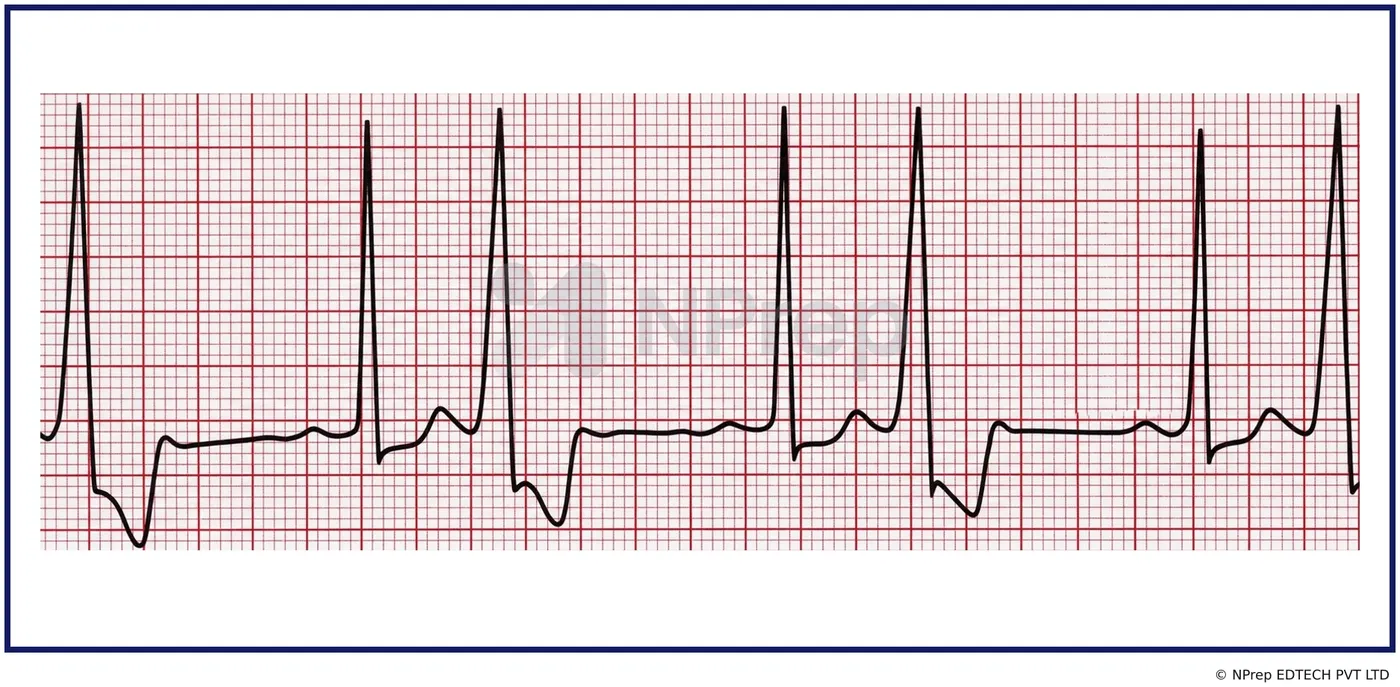
- A.
Supraventricular tachycardia
- B.
Ventricular bigeminy
- C.
Second-degree heart block
- D.
Atrial fibrillation
- A.
Q79 · Medical & Surgical Nursing · Other Acute Problems
patient is assessed using a MAP scoring system in a clinical setting. The score is found to be high. What does this most likely indicate?
- A.
The patient is stable with low risk of complications
- B.
The patient has a good prognosis and requires routine care
- C.
The patient is at high risk with poor clinical condition and requires close monitoring
- D.
The score is invalid and should be repeated in all cases
- A.
Q80 · Nursing Research & Statistics · Research Approaches and Designs
In a clinical research study, the treatment is changed during the trial. Only the nurse administering the treatment knows about the change, while the participant is unaware of it. Which type of study design is this?
- A.
Open-label study.
- B.
Triple-blind study
- C.
Single-blind study
- D.
Double-blind study
- A.
Q81 · Medical & Surgical Nursing · Digestive and Gastrointestinal Function
A patient complains of difficulty swallowing both liquids and solids and has frequent regurgitation of undigested food. A barium swallow shows the classical"bird-beak" appearance. This finding is most characteristic of?
- A.
Irritable bowel syndrome (IBS)
- B.
Achalasia cardia
- C.
Gastroesophageal reflux disease (GERD)
- D.
Ulcerative colitis
- A.
Q82 · Community Health Nursing · Health Agencies
Which of the following organizations provides financial support for medical and health services?.
- A.
UNICEF
- B.
World Bank
- C.
ICMR
- D.
WHO
- A.
Q83 · Community Health Nursing · Epidemiology – Epidemiological Approaches and Processes
Clustered ases of diarrhea occurring around a contaminated well represent which type of epidemic?
- A.
Propagated epidemic
- B.
Continuous common source epidemic
- C.
Point source epidemic
- D.
More number of actual cases than expected
- A.
Q84 · Community Health Nursing · Epidemiology – Epidemiological Approaches and Processes
During a field immunization session, the nurse observes that out of 10 vaccine vials, 3 are at VVM Stage 3 and the remaining 7 are at VVM Stage 1. What should be the next step?
- A.
Use all vaccine vials until their expiry date.
- B.
Discard the 3 vaccine vials with VVM Stage 3 and use the remaining VVM Stage 1vials.
- C.
Stop the immunization session and inform the Medical Officer.
- D.
Discard all vaccine vials.
- A.
Q85 · Obstetrics & Gynaecology · Hypertensive Disorders in Pregnancy
A pregnant woman has a blood pressure of 152/96 mmHg, +2 proteinuria, and a persistent severe headache that does not improve. What is the most appropriate nursing action?
- A.
Reassess the blood pressure after 15 minutes
- B.
Perform a non-stress test (NST)
- C.
Initiate seizure precautions
- D.
Administer acetaminophen for headache
- A.
Q86 · Nursing Education · Introduction and Theoretical Foundations
A teacher explains the anatomy of the heart first, followed by pulmonary and systemic circulation. Which teaching maximum is being applied?
- A.
Simple to complex
- B.
Psychological to logical
- C.
Concrete to abstract
- D.
Known to unknown
- A.
Q87 · Nursing Research & Statistics · Normal Distribution and Measures of Relationship
Which of the following statistical tests is used to determine the relationship between two continuous variables?
- A.
Chi-square test
- B.
Pearson correlation coefficient
- C.
Paired t-test
- D.
ANOVA
- A.
Q88 · Mental Health Nursing · Behavioural & Emotional Disorders of Childhood and Adolescence
he parents of a child report that the child steals small items, shows little or no remorse when caught, and frequently bullies younger children at school. Which of the following is the most likely diagnosis?
- A.
Oppositional defiant disorder (ODD)
- B.
Attention-deficit/hyperactivity disorder (ADHD)
- C.
Conduct disorder
- D.
Conversion disorder
- A.
Q89 · Mental Health Nursing · Neurotic, stress related and somatisation disorders
Generalized Anxiety Disorder (GAD), which neurotransmitter abnormality is most commonly associated?
- A.
Increased dopamine
- B.
Decreased acetylcholine
- C.
Increased serotonin
- D.
Decreased GABA
- A.
Q90 · Medical & Surgical Nursing · Integumentary Function
Which of the following conditions is associated with nails?
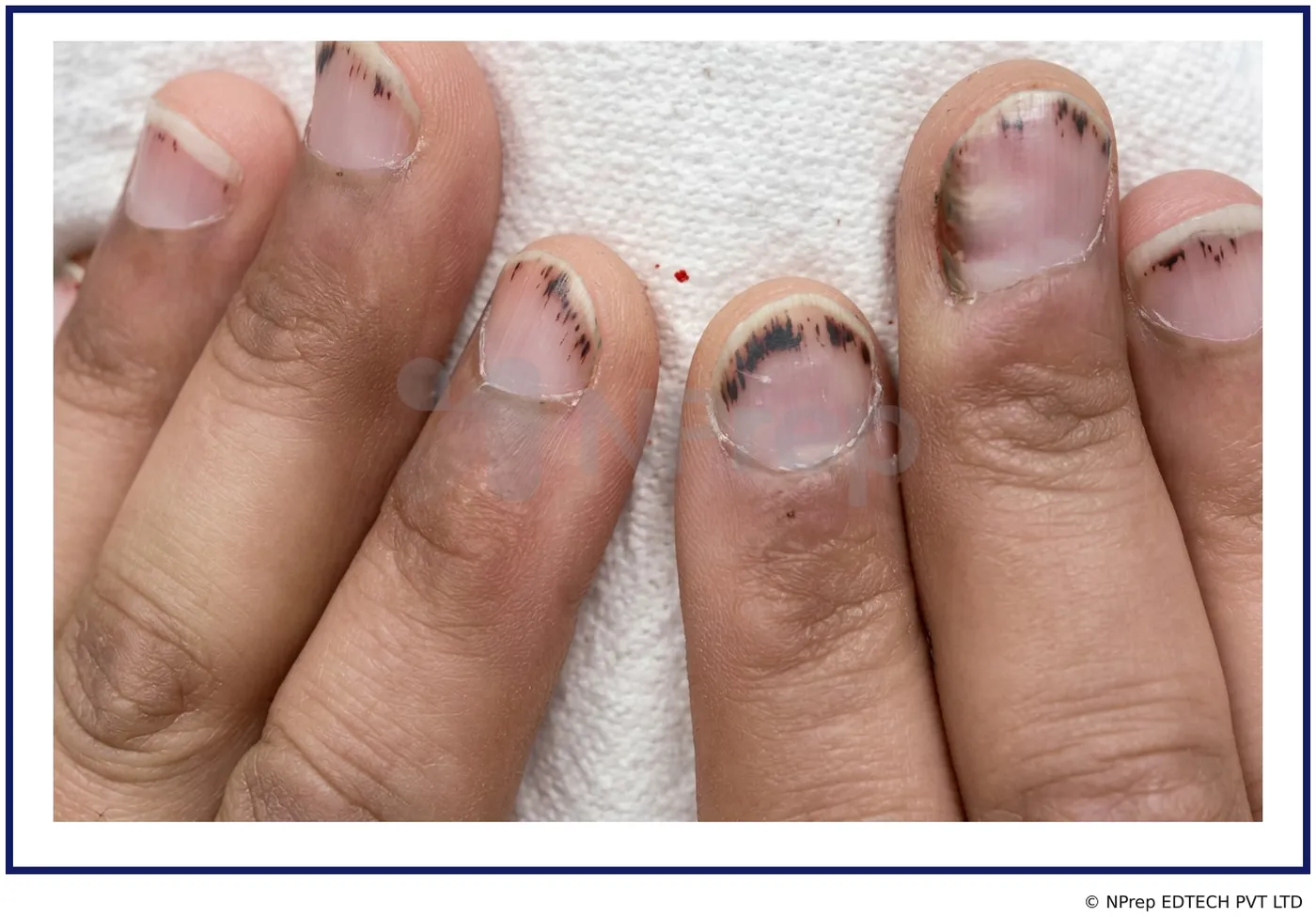
- A.
lron deficiency anemia (IDA)
- B.
Psoriasis
- C.
Infective endocarditis
- D.
kidney disease
- A.