RUHS Jaipur M.Sc Nursing Entrance 2023 question paper
RUHS M.Sc Nursing Entrance · 2023 · 120 questions · 120 minutes
- Medical & Surgical Nursing 23
- Nursing Foundations 12
- Obstetrics & Gynaecology 11
- Community Health Nursing 10
- Mental Health Nursing 10
- Child Health Nursing (Pediatrics) 7
- Applied Anatomy 6
- Nursing Management & Leadership 5
- Applied Sociology 5
- Applied Microbiology & Infection control 5
- Nursing Research & Statistics 4
- Applied Psychology 4
- Pharmacology 4
- Applied Nutrition & Dietetics 4
- Biochemistry & Nutrition 4
- Applied Physiology 2
- Pathology & Genetics 2
- General Knowledge 1
- Nursing Education 1
See the answers and explanations
Sign in free: every answer with its explanation, attempt the paper timed with negative marking, and track your score.
Q1 · Medical & Surgical Nursing · Metabolic and Endocrine Function
Addison's disease is otherwise called as
- A.
Acute adrenocortical insufficiency
- B.
Hyperpituitarism
- C.
Chronic adrenocortical insufficiency
- D.
Hyperaldosteronism
- A.
Q2 · Obstetrics & Gynaecology · Injuries to the Birth Canal
The bone most frequently fractured during delivery is
- A.
Radius
- B.
Clavicle
- C.
Humerus
- D.
Ulna
- A.
Q3 · Obstetrics & Gynaecology · Vomiting in Pregnancy
A 25 - year old primigravida presents at 8 weeks of gestation with hyperemesis. Which of these is not included in the triad of hyperemesis ?
- A.
Dehydration
- B.
Weight loss
- C.
Ketosis
- D.
Increased appetite
- A.
Q4 · Community Health Nursing · Concepts of Community Health and Community Health Nursing
Possessing the abilities and resources to accomplish family development task is known as
- A.
Family health
- B.
Family development
- C.
Group function
- D.
Community health
- A.
Q5 · Medical & Surgical Nursing · Perioperative Concepts and Nursing Management
Which of the following respiratory complication is most common after surgery?
- A.
Pulmonary embolism
- B.
Empyema
- C.
Atelectasis
- D.
Pulmonary edema
- A.
Q6 · Applied Anatomy · Digestive System
Number of deciduous teeth is
- A.
20
- B.
24
- C.
28
- D.
32
- A.
Q7 · Applied Physiology · Respiratory system
Muscles of inspiration include all except
- A.
Diaphragm
- B.
External intercostals
- C.
Sternocleidomastoid
- D.
Internal intercostals
- A.
Q8 · Medical & Surgical Nursing · Musculoskeletal Function
Deficiency of vitamin D in adult's causes
- A.
Osteomalacia
- B.
Osteoporosis
- C.
Rickets
- D.
Bone deformities
- A.
Q9 · Community Health Nursing · National Health Programs
Under the National Anemia Prophylaxis Programme, how much elemental iron should all pregnant and lactating mothers receive?
- A.
50 mg of elemental iron
- B.
80 mg of elemental iron
- C.
100 mg of elemental iron
- D.
150 mg of elemental iron
- A.
Q10 · Child Health Nursing (Pediatrics) · Newborn Infants
When do you called child as a premature
- A.
When the birth weight is 3.5 kg
- B.
4 kgs birth weight
- C.
3 kgs of birth weight
- D.
2.5 kg of birth weight or less than
- A.
Q11 · Nursing Foundations · Communication & Nurse-Patient Relationship
An important aspect of nurses patient relationship is
- A.
Therapeutic
- B.
Personal
- C.
Social
- D.
Causal
- A.
Q12 · Nursing Research & Statistics · Tools and Methods of Data Collection
Documented evidence (data) gathered through direct observation rather than a researcher's subjective belief is :
- A.
Qualitative data
- B.
Quantitative data
- C.
Empirical data
- D.
Objective data
- A.
Q13 · Child Health Nursing (Pediatrics) · Miscellaneous
Incubation period of pertussis is:
- A.
7-14 days
- B.
Less than 2 weeks
- C.
16-28 days
- D.
6 weeks
- A.
Q14 · Mental Health Nursing · Neurotic, stress related and somatisation disorders
Persistent unrealistic intensive fear of an object, place or situation is
- A.
Seizure
- B.
Phobia
- C.
Hysteria
- D.
Illusion
- A.
Q15 · Community Health Nursing · Assisting individuals and families to promote and maintain their health
Current concept of health promotion and the related activities lead to:
- A.
Better treatment of a problem
- B.
Critical awareness and life style changes
- C.
Adoption of prophylactic services
- D.
Better health services usages
- A.
Q16 · Obstetrics & Gynaecology · Medical and Surgical Illness Complicating Pregnancy
According to ICMR, severe anemia in pregnancy is defined as hemoglobin below what value
- A.
11 g/dL
- B.
10 g/dL
- C.
7 g/dL
- D.
4 g/dL
- A.
Q17 · Mental Health Nursing · Neurotic, stress related and somatisation disorders
Post traumatic stress disorder is because of
- A.
Vascular accident
- B.
Major life threatening events
- C.
Minor stress
- D.
Head injury
- A.
Q18 · Applied Psychology · Psychological assessment & tests
Checklist and rating scales as tools of counselling are
- A.
Testing tools
- B.
Non testing tools
- C.
Standardized tools
- D.
Personality tools
- A.
Q19 · Medical & Surgical Nursing · Digestive and Gastrointestinal Function
Priority nursing intervention in the immediate post gastroscopy period will be :
- A.
Administer oxygen
- B.
Assess gag reflex prior to administration of fluids
- C.
Administer ordered fluid and drugs
- D.
Replace NG drainage every 2 hourly
- A.
Q20 · Nursing Management & Leadership · In-Service Education
The planned educational experiences provided in a job setting is :
- A.
Curricular education
- B.
In service education
- C.
Primary education
- D.
Specialized education
- A.
Q21 · Medical & Surgical Nursing · Miscellaneous
Kussmaul's respirations is increased respiratory rate, increased depth, panting labored breathing causes in:
- A.
Hypertension
- B.
Diabetic ketoacidosis
- C.
Bronchial asthma
- D.
Pneumonia
- A.
Q22 · Medical & Surgical Nursing · Integumentary Function
Which type of solution is commonly used for the fluid replacement in burns?
- A.
Hartmann solution
- B.
Normal saline
- C.
5% dextrose
- D.
5% dextrose in normal saline
- A.
Q23 · Applied Sociology · Social stratification
In which of the following types of systems is a person's right and rank in the society determined by his birth into a particular group ?
- A.
Estate system
- B.
Meritocracy
- C.
Caste system
- D.
Class system
- A.
Q24 · Applied Anatomy · Musculoskeletal System
What provides the framework of synthesis of the cancellous bone tissue within metaphysis?
- A.
Diaphis plate
- B.
Epiphysis plate
- C.
Epiphyseal plate
- D.
Metaphysical
- A.
Q25 · Community Health Nursing · National Health Programs
Child survival and safe motherhood programme was introduced by
- A.
World Health Organization (WHO)
- B.
Ministry of Health (MOH)
- C.
Indian Academy of Pediatrics (IAP)
- D.
National Neonatology Forum (NNF)
- A.
- Sign in free
Done 25 questions? Check your answers
Sign in free: every answer with its explanation, attempt the paper timed with negative marking, and track your score.
Q26 · Medical & Surgical Nursing · Gas Exchange and Respiratory Function
Which of the following nasal dysfunction is commonly due to degenerative changes in the skeletal framework of the nose?
- A.
Polypsia
- B.
Nasal obstruction
- C.
Rhinorrhea
- D.
Epistaxis
- A.
Q27 · Medical & Surgical Nursing · Other Acute Problems
Which of the pulse is palpated to see the effectiveness of CPR ?
- A.
Ulnar
- B.
Carotid pulse
- C.
Radial pulse
- D.
Temporal pulse
- A.
Q28 · Pharmacology · Miscellaneous
The following is generally the drug of first choice in typhoid
- A.
Amoxicillin
- B.
Tetracycline
- C.
Erythromycin
- D.
Ciprofloxacin
- A.
Q29 · Applied Nutrition & Dietetics · Introduction to Nutrition
Examples for the micro nutrients are
- A.
Calcium
- B.
CHO (Carbohydrates)
- C.
Fats
- D.
Nutrients
- A.
Q30 · Applied Microbiology & Infection control · Disinfection and Sterilization
The most effective sterilizing procedure is
- A.
Sunlight
- B.
Boiling
- C.
Hot air oven
- D.
Radiation
- A.
Q31 · General Knowledge · Miscellaneous
It refers to the preparation of the bed with a new set of linens:
- A.
Bed bath
- B.
Bed making
- C.
Bed shampoo
- D.
Bed lining
- A.
Q32 · Pharmacology · General Pharmacology
Pharmacodynamics is the study of :
- A.
What the drug does to the body
- B.
What the body does to the drug
- C.
What the body and the drug do to each other
- D.
Absorption of the drug
- A.
Q33 · Mental Health Nursing · Substance Use Disorders
When talking about alcohol and drug abuse the nurse should be aware that
- A.
Most poly drug abusers also abuse alcohol
- B.
Most alcoholic become poly drug abuser
- C.
Addictive individual tend to use hostile, abusive behaviour
- D.
An unhappy childhood is a causative factor in many addicts
- A.
Q34 · Medical & Surgical Nursing · Digestive and Gastrointestinal Function
Which of the following is most likely to validate that a client is experiencing intestinal bleeding ?
- A.
Large quantities of fat mixed with pale yellow liquid stool
- B.
Brown formed stool
- C.
Semi soft tar colored stools
- D.
Narrow, pencil shaped stool
- A.
Q35 · Pharmacology · Introduction to drugs used in alternative systems of medicine
The system of medicine which is originated from Tamil Nadu State is:
- A.
Ayurveda
- B.
Siddha
- C.
Homeopathy
- D.
Unani-Tibb
- A.
Q36 · Community Health Nursing · Demography, Surveillance and Interpretation of Data
The continuous scrutiny of all aspects of occurrence and spread of disease that are pertinent to effective control is known as
- A.
Quarantine
- B.
Screening
- C.
Surveillance
- D.
Monitoring
- A.
Q37 · Mental Health Nursing · Schizophrenia
A rope in a dark room is perceived as a snake. This is an example of :
- A.
Perceptual set
- B.
Hallucination
- C.
Illusion
- D.
Retinal disparity
- A.
Q38 · Nursing Foundations · Introduction to Health & Illness
Priorities of planning in Nursing process is done by
- A.
Information processing model
- B.
Interpersonal theory
- C.
Stages of illness model
- D.
Maslow's hierarchy of human needs
- A.
Q39 · Applied Sociology · Family and Marriage
After marriage if the wife resides in her husband's house, descent and property is traced through the male line, the system is known as:
- A.
Matriarchal family
- B.
Patriarchal family
- C.
Orientation family
- D.
Extended family
- A.
Q40 · Medical & Surgical Nursing · Neurologic Function
Glasgow coma scale has all, except:
- A.
Verbal response
- B.
Motor response
- C.
Sensory response
- D.
Eye opening
- A.
Q41 · Mental Health Nursing · Treatment modalities and therapies used in mental disorders
A client diagnosed with major depressive disorder and experiencing suicidal ideation is showing signs of anxiety. Alprazolam (Xanax) is prescribed. Which assessment should be prioritized
- A.
Monitor for signs and symptoms of physical and psychological withdrawal
- B.
Teach the client about side effects of the medication and how to handle these side effects
- C.
Assess for nausea and give the medication with food if nausea occurs
- D.
Ask the client to rate his or her mood on a mood scale and monitor for suicidal ideations
- A.
Q42 · Applied Nutrition & Dietetics · Proteins
What percentage of proteins contributes to the total energy in Indian diets?
- A.
1-5%
- B.
10-15%
- C.
20-25%
- D.
50-65%
- A.
Q43 · Nursing Foundations · Elimination needs
The nurse understands that urine flows through a Foley’s catheter by the principle of
- A.
Higher pressure to lower pressure
- B.
Gravity
- C.
Suction
- D.
Siphoning
- A.
Q44 · Obstetrics & Gynaecology · Physiological Changes During Pregnancy
What is the total weight gain during pregnancy?
- A.
5kg
- B.
8kg
- C.
10kg
- D.
12.5kg
- A.
Q45 · Obstetrics & Gynaecology · Hypertensive Disorders in Pregnancy
Which of the following is not one of the danger signs of pre-eclampsia?
- A.
Persistent headache
- B.
Vision disturbance
- C.
Pain abdomen
- D.
Pulmonary edema
- A.
Q46 · Nursing Foundations · Administration of medications
The preferred route of administration in an unconscious patient is :
- A.
Sublingual
- B.
Oral
- C.
Intravenous
- D.
Nasal
- A.
Q47 · Obstetrics & Gynaecology · Abnormalities of the Puerperium
Which of the following does not cause the subinvolution of the uterus ?
- A.
Retained Placental fragments
- B.
Pelvic infection
- C.
Anemia
- D.
Complete perineal tear
- A.
Q48 · Medical & Surgical Nursing · Miscellaneous
Any disturbance that blocks the transmission of nerve impulse from SA node downwards is known as :
- A.
Heart block
- B.
Heart attack
- C.
Nerve block
- D.
Nerve block cardiac arrhythmias
- A.
Q49 · Applied Microbiology & Infection control · General Characteristics of Microbes
Free living microbes that live on dead or decaying organic matter are known as
- A.
Parasites
- B.
Saprophytes
- C.
Commensals
- D.
Pathogens
- A.
Q50 · Obstetrics & Gynaecology · Pharmacotherapeutics in Obstetrics
What is the average requirement of iron in the third trimester ?
- A.
2-4 mg/day
- B.
4-6 mg/day
- C.
6-8 mg/day
- D.
8-10 mg/day
- A.
- Sign in free
Done 50 questions? Check your answers
Sign in free: every answer with its explanation, attempt the paper timed with negative marking, and track your score.
Q51 · Child Health Nursing (Pediatrics) · Normal Growth and its Disorders
The average increase of head circumference from birth to 6 months is
- A.
0.5 cm / month
- B.
1 cm / month
- C.
1.5 cm / month
- D.
2 cm / month
- A.
Q52 · Nursing Foundations · Nursing Process
The interpretation of the data collected about the patient represents the:
- A.
Assessment of the patient
- B.
Health problems of the patient
- C.
Proposed plan of care for the patient
- D.
Nursing interventions done for the patient
- A.
Q53 · Pathology & Genetics · Genetics
Blood group which is not likely to be present in a baby born to mother with O positive and father with A negative blood group
- A.
A positive
- B.
A negative
- C.
O positive
- D.
AB positive
- A.
Q54 · Medical & Surgical Nursing · Gas Exchange and Respiratory Function
The nurse understands that the patient diagnosed with pulmonary embolism will be treated by
- A.
Streptokinase
- B.
Tissue plasminogen activator
- C.
IV heparin sodium
- D.
Sodium warfarin
- A.
Q55 · Community Health Nursing · Epidemiology – Epidemiological Approaches and Processes
Herd immunity does not protect an individual in
- A.
Diphtheria
- B.
Poliomyelitis
- C.
Smallpox
- D.
Tetanus
- A.
Q56 · Applied Anatomy · Digestive System
The most common site of occurring peptic ulcers in stomach:
- A.
Pyloric portion
- B.
Cardiac portion
- C.
Esophageal junction
- D.
Body of the stomach
- A.
Q57 · Applied Anatomy · Digestive System
Capacity of gall bladder is around
- A.
150 ml
- B.
250 ml
- C.
50 ml
- D.
500 ml
- A.
Q58 · Applied Microbiology & Infection control · Disinfection and Sterilization
Steaming of material at 100°C for 20 minutes for 3 consecutive days is
- A.
Inspissation
- B.
Tyndallisation
- C.
Pasteurisation
- D.
Incineration
- A.
Q59 · Medical & Surgical Nursing · Neurologic Function
Parkinsons's disease is caused by:
- A.
Degeneration of substantia nigra depleting dopamine production
- B.
Ischemic in the brain stem producing motor disorder
- C.
A post-viral illness causing ascending paresthesia
- D.
An autoimmune disorders that destroy acetylcholine receptors
- A.
Q60 · Community Health Nursing · Environmental Science, Environmental Health, and Sanitation
The establishment of 'green belts' in the prevention and control of air pollution is a method of:
- A.
Containment
- B.
Replacement
- C.
Legislation
- D.
Dilution
- A.
Q61 · Medical & Surgical Nursing · Miscellaneous
The most common cause of acute appendicitis is :
- A.
A fecalith
- B.
Kinking of appendix
- C.
Tumor in the cecum
- D.
External occlusion of the bowel by adhesions
- A.
Q62 · Nursing Research & Statistics · Analysis of data
Variables are arranged either in ascending or descending order of magnitude to determine
- A.
Mean
- B.
Histogram
- C.
Median
- D.
Pie chart
- A.
Q63 · Medical & Surgical Nursing · Gas Exchange and Respiratory Function
Which of the following nursing actions in most essential for a patient with an endotracheal (ET) tube?
- A.
Monitoring proper placement of the tube every 2 hours
- B.
Suctioning endotracheal tube every 1 hour
- C.
Monitoring arterial blood gas every 4 hours
- D.
Provide frequent oral care
- A.
Q64 · Community Health Nursing · Epidemiology – Epidemiological Approaches and Processes
Administration of oral polio vaccine to the children is a measure of:
- A.
Health promotion
- B.
Specific protection
- C.
Treatment
- D.
Rehabilitation
- A.
Q65 · Applied Physiology · Circulatory & Lymphatic system
The volume of blood that is pumped out by each ventricle at each heart beat is called
- A.
Cardiac output
- B.
Stroke volume
- C.
Cardiac cycle
- D.
Tidal volume
- A.
Q66 · Community Health Nursing · Epidemiology – Epidemiological Approaches and Processes
Experimental epidemiology deals with
- A.
Epidemics
- B.
Intervention or modification
- C.
Screening of disease
- D.
Early diagnosis
- A.
Q67 · Applied Nutrition & Dietetics · Vitamins
Rich sources of vitamin C are
- A.
Amla
- B.
Apple
- C.
Orange
- D.
Spinach
- A.
Q68 · Obstetrics & Gynaecology · Diagnosis of Pregnancy
What is the characteristic violet discolouration of the vagina during pregnancy called
- A.
Hegar's sign
- B.
Chadwick's sign
- C.
Osiander's sign
- D.
Palmer's sign
- A.
Q69 · Nursing Management & Leadership · Management Basics Applied to Nursing
Henry Fayol suggested the following principles of management except
- A.
Division of work
- B.
Authority and responsibility
- C.
Scalar chain
- D.
Principle of time and motion
- A.
Q70 · Medical & Surgical Nursing · Digestive and Gastrointestinal Function
A foul smelling frothy stool in cystic fibrosis result from the presence of large amount of
- A.
Phenylalanine
- B.
Undigested fat
- C.
Undigested CHO
- D.
Undigested protein
- A.
Q71 · Applied Sociology · Social stratification
When people change their position in a social hierarchy it is called
- A.
Social justice
- B.
Social structural mobility
- C.
Class system
- D.
Social mobility
- A.
Q72 · Nursing Foundations · Administration of medications
One ml is equivalent to macro drops
- A.
15
- B.
25
- C.
35
- D.
55
- A.
Q73 · Nursing Foundations · Introduction to Health & Illness
Health is a state where every cell and every organ is functioning at optimum capacity. The definition of health is given under the following dimension of health:
- A.
Biological dimension
- B.
Physical dimension
- C.
Physiological dimension
- D.
Vocational dimension
- A.
Q74 · Mental Health Nursing · Neurotic, stress related and somatisation disorders
Excessive worrying, muscle tension, headaches, sweating, tiredness, trembling and nausea may be symptoms of :
- A.
OCD
- B.
Phobia
- C.
Hysteria
- D.
Generalised anxiety disorder
- A.
Q75 · Applied Anatomy · Reproductive System
Which of the following does not support the vagina ?
- A.
Perineal body
- B.
Levator ani muscle
- C.
Broad ligament
- D.
Cardinal ligament
- A.
- Sign in free
Done 75 questions? Check your answers
Sign in free: every answer with its explanation, attempt the paper timed with negative marking, and track your score.
Q76 · Nursing Foundations · Health Assessment
Observation is the method of
- A.
Assessment
- B.
Planning
- C.
Evaluation
- D.
Data collection
- A.
Q77 · Nursing Education · Introduction and Theoretical Foundations
Naturalism philosophy emphasizes
- A.
Rigid discipline to child
- B.
Free discipline to child in nature
- C.
Spontaneous and self discipline to child in nature
- D.
No discipline to child in nature
- A.
Q78 · Nursing Management & Leadership · Management Process
The process of assignment of activities and laying down of line and staff relationship is called
- A.
Staffing
- B.
Organizing
- C.
Planning
- D.
Directing
- A.
Q79 · Medical & Surgical Nursing · Gas Exchange and Respiratory Function
What is the term used for a high-pitched musical sound in clients during a respiratory assessment ?
- A.
Crowing
- B.
Wheezing
- C.
Stridor
- D.
Sigh
- A.
Q80 · Biochemistry & Nutrition · Insulin, Glucose Homeostasis & Diabetes Mellitus
Gluconeogenesis is decreased by
- A.
Glucagon
- B.
Epinephrine
- C.
Glucocorticoids
- D.
Insulin
- A.
Q81 · Nursing Research & Statistics · Tools and Methods of Data Collection
Which of the following is not a primary data collection technique?
- A.
Observation
- B.
Personal interview
- C.
Questionnaire
- D.
Monthly report
- A.
Q82 · Medical & Surgical Nursing · Cardiovascular, Circulatory, and Hematologic Function
The most common complication after acute myocardial infarction is :
- A.
Cardiac tamponade
- B.
Cardiac failure
- C.
Pulmonary embolism
- D.
Dysrhythmias
- A.
Q83 · Applied Nutrition & Dietetics · Vitamins
Follicular hyperkeratosis is also called as
- A.
Bitots spots
- B.
Xerosis cornea
- C.
Phrynoderma
- D.
Keratomalacia
- A.
Q84 · Mental Health Nursing · Treatment modalities and therapies used in mental disorders
ECT is not indicated in
- A.
Catatonic schizophrenia
- B.
Acute depression
- C.
Obsessive compulsive neurosis
- D.
Acute mania
- A.
Q85 · Nursing Management & Leadership · Management Basics Applied to Nursing
Who is acknowledged as "father" of modern management theory?
- A.
Henry Fayol
- B.
Elton Mayo
- C.
Mc Gregor
- D.
F W Taylor
- A.
Q86 · Applied Psychology · Soft Skills & its applications
Johari window facilitates understanding of
- A.
One's own strengths and limitation
- B.
Implementation of nursing process
- C.
Learning theories
- D.
Feedback mechanism
- A.
Q87 · Biochemistry & Nutrition · Miscellaneous
The boiling point of water is
- A.
121°C
- B.
140°C
- C.
200°C
- D.
100°C
- A.
Q88 · Child Health Nursing (Pediatrics) · Common Medical Procedures
Mummy restraints are used in
- A.
Adolescents
- B.
Adults
- C.
Old age patient
- D.
Small children
- A.
Q89 · Biochemistry & Nutrition · Nucleic acid & Nucleotides
Increased uric acid levels are found in
- A.
Gout
- B.
Wilson disease
- C.
Fanconi syndrome
- D.
Yellow atrophy of liver
- A.
Q90 · Pharmacology · Antimicrobial Drugs
The following is used in roundworm infestation :
- A.
Metronidazole
- B.
Albendazole
- C.
Clotrimazole
- D.
Fluconazole
- A.
Q91 · Obstetrics & Gynaecology · Medical and Surgical Illness Complicating Pregnancy
What is the target postprandial blood glucose in the control of GDM pregnancy?
- A.
< 100 mg /dL
- B.
110 - 120 mg/dL
- C.
120-140 mg / dL
- D.
140-200 mg/dL
- A.
Q92 · Pathology & Genetics · Miscellaneous
The patients of following blood group have highest tendency of gastric carcinoma
- A.
Blood group A
- B.
Blood group O
- C.
AB blood group
- D.
Blood group B
- A.
Q93 · Nursing Research & Statistics · Research Approaches and Designs
Any research which makes use of observation based on past events is known as:
- A.
Trend approach
- B.
Time series
- C.
Event approach
- D.
Historical approach
- A.
Q94 · Applied Anatomy · Musculoskeletal System
Total number of cervical, thoracic and lumbar vertebrae comes to:
- A.
24
- B.
33
- C.
37
- D.
27
- A.
Q95 · Applied Psychology · Miscellaneous
A person who is avoiding becoming aware of some painful aspect of reality is
- A.
Denial
- B.
Projection
- C.
Deteriorating
- D.
Acceptance
- A.
Q96 · Medical & Surgical Nursing · Shock and Multisystem Failure
Immediate management of choice to restore B.P. and peripheral circulation is:
- A.
Trendelenburg position
- B.
Ringer lactate
- C.
Colloids
- D.
Inotropes
- A.
Q97 · Mental Health Nursing · Principles and Concepts of Mental Health Nursing
Which of the following does not influence mental health ?
- A.
Heredity
- B.
Childhood experiences
- C.
Education
- D.
Physical health
- A.
Q98 · Applied Microbiology & Infection control · Hand Hygiene
Why is hand washing a very important step in the procedure for care of a wound?
- A.
To avoid any further injury
- B.
To cover the wound and quickens healing
- C.
To prevent cross contamination
- D.
This helps remove extra moisture from the wound
- A.
Q99 · Nursing Foundations · Health Assessment
Which of the following technique involves the sense of sight?
- A.
Inspection
- B.
Palpation
- C.
Percussion
- D.
Auscultation
- A.
Q100 · Medical & Surgical Nursing · Neurologic Function
What is the first thing a nurse should assess to determine the presence of neurological changes?
- A.
Vital signs
- B.
Mental status
- C.
Reflexes
- D.
Level of consciousness
- A.
- Sign in free
Done 100 questions? Check your answers
Sign in free: every answer with its explanation, attempt the paper timed with negative marking, and track your score.
Q101 · Mental Health Nursing · Therapeutic Communication and Nurse- Patient Relationship
When helping a very confused, elderly client, the best approach is to provide an environment with
- A.
A specific routine
- B.
Group involvement
- C.
A trusting relationship
- D.
Activities that are varied
- A.
Q102 · Child Health Nursing (Pediatrics) · Immunization and Immunodeficiency
The nurse is employed in well baby clinic to administer vaccines. Which of the following is present is a contraindication for receiving immunization?
- A.
Vomiting
- B.
Excessive crying
- C.
Diarrhea
- D.
Fever
- A.
Q103 · Obstetrics & Gynaecology · Diagnosis of Pregnancy
Softening of the lower uterine segment just above the cervix is called
- A.
Hegar's sign
- B.
Chadwick's sign
- C.
Osiander's sign
- D.
Palmer's sign
- A.
Q104 · Nursing Foundations · History of Nursing & Nursing as a profession
The pioneer of the modern nursing is
- A.
Adhoka
- B.
Paula
- C.
Florence nightingale
- D.
Marcella
- A.
Q105 · Applied Sociology · Social organization and disorganization
Professional organization is an example of :
- A.
Active agency
- B.
Passive agency
- C.
Formal agency
- D.
Nonformal agency
- A.
Q106 · Applied Microbiology & Infection control · Disinfection and Sterilization
Which of the following is most powerful chemical disinfectant ?
- A.
Phenol
- B.
Lysol
- C.
Dettol
- D.
Potassium permanganate
- A.
Q107 · Nursing Foundations · Health Assessment
Which assessment information would be evaluated as objective data?
- A.
Clinical institute withdrawal assessment (CIWA) score of 10
- B.
Client's statements of generalized anxiety
- C.
Complaints of anorexia
- D.
Client states, "I can't keep my thoughts together"
- A.
Q108 · Community Health Nursing · Health Care Planning and Organization of Health Care at various levels
The concept of primary health centre was first given by :
- A.
Bhore committee
- B.
Mudaliar committee
- C.
Chadha committee
- D.
Shrivastav committee
- A.
Q109 · Mental Health Nursing · Personality and Sexual Disorders
A person with an antisocial personality disorder has difficulty relating to others. Because the person has never learned to
- A.
Count on others
- B.
Empathize with others
- C.
Be dependent on others
- D.
Communicate with other socially
- A.
Q110 · Nursing Management & Leadership · Nursing as a Profession
The process of determining and maintaining competence in nursing practice to uphold the standard of nursing profession is called
- A.
Licensure
- B.
Registration
- C.
Credentialing
- D.
Certification
- A.
Q111 · Medical & Surgical Nursing · Gas Exchange and Respiratory Function
When the patient is on mechanical ventilation which of the following equipment should be kept ready at bedside ?
- A.
Water seal chest drainage
- B.
Manual resuscitation bag
- C.
Oxygen analyser
- D.
Tracheostomy cleaning kit
- A.
Q112 · Child Health Nursing (Pediatrics) · Development
Autism can usually be diagnosed when the child is about
- A.
1 month
- B.
2 month
- C.
2 years
- D.
14 years
- A.
Q113 · Obstetrics & Gynaecology · Normal Puerperium
Following delivery, the uterus becomes a pelvic organ at
- A.
24 hours post - delivery
- B.
48 hours post - delivery
- C.
1 week post - delivery
- D.
2 weeks post - delivery
- A.
Q114 · Applied Sociology · Family and Marriage
Other term for multigenerational family :
- A.
Joint family
- B.
Nuclear family
- C.
Extended family
- D.
Single family
- A.
Q115 · Medical & Surgical Nursing · Cardiovascular, Circulatory, and Hematologic Function
Which among the following is the most specific marker for the diagnosis of acute myocardial infarction ?
- A.
Troponin
- B.
Creatinine kinase
- C.
LDH
- D.
Myoglobin
- A.
Q116 · Nursing Foundations · Health Assessment
What position best facilitates this assessment ?
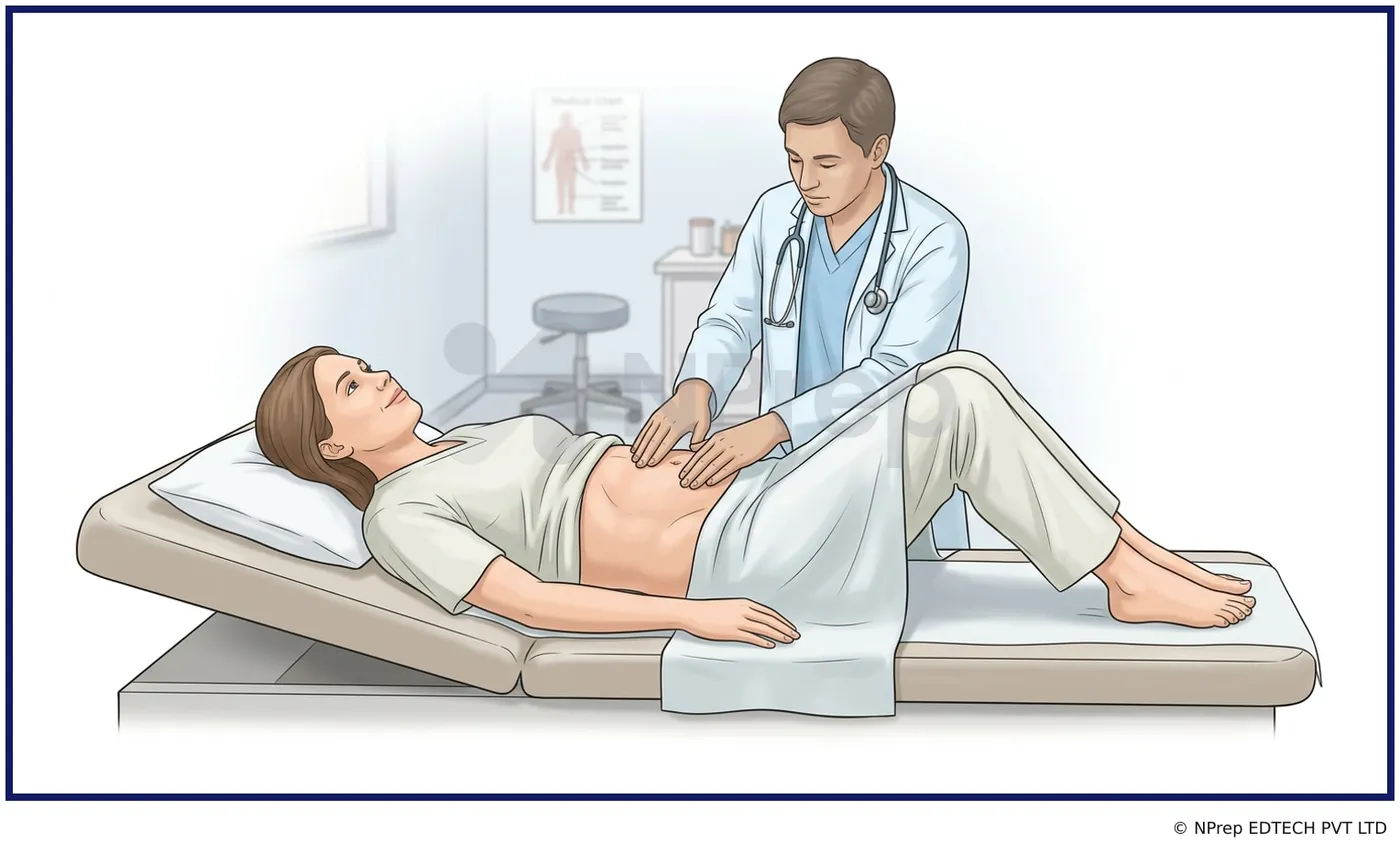
- A.
Sims
- B.
Lithotomy
- C.
Dorsal recumbent
- D.
High fowler's
- A.
Q117 · Medical & Surgical Nursing · Gas Exchange and Respiratory Function
Nurse Ramya is suctioning a tracheostomy tube of an adult patient. During the procedure, the catheter appears to attach to the tracheal wall and creates a pulling sensation. What is the best action for the nurse to take?
- A.
Continue suctioning until the obstruction removed
- B.
Increase the pressure of suction
- C.
Insert the tube deeper and apply more pressure
- D.
Release the suction by opening the vent
- A.
Q118 · Applied Psychology · Personality
Which of the following is not true about the id ?
- A.
It is based on the pleasure principle
- B.
It deals with our conscience
- C.
It is present at birth
- D.
It contains aggressive instinct
- A.
Q119 · Biochemistry & Nutrition · Miscellaneous
Benedict's test is less likely to give weakly positive results with concentrated urine due to the action of
- A.
Urea
- B.
Uric acid
- C.
Ammonium salts
- D.
Phosphates
- A.
Q120 · Child Health Nursing (Pediatrics) · Disorders of Kidney and Urinary Tract
The dietary changes that a nurse would implement with a 2 year child who is in the acute stage of Nephrotic syndrome is :
- A.
Increased iron intake
- B.
Decreased fat intake
- C.
Decreased sodium intake
- D.
Increased protein intake
- A.
More RUHS M.Sc Nursing Entrance papers
- RUHS Jaipur M.Sc Nursing Entrance 20242024 · 120 questions
- RUHS Jaipur M.Sc Nursing Entrance 20222022 · 120 questions
- RUHS Jaipur M.Sc Nursing Entrance 20212021 · 120 questions
- RUHS Jaipur M.Sc Nursing Entrance 20192019 · 120 questions
- RUHS Jaipur M.Sc Nursing Entrance 20182018 · 120 questions
- RUHS Jaipur M.Sc Nursing Entrance 20162016 · 120 questions
- RUHS Jaipur M.Sc Nursing Entrance 20152015 · 120 questions