RUHS Jaipur M.Sc Nursing Entrance 2024 question paper
RUHS M.Sc Nursing Entrance · 2024 · 120 questions · 120 minutes
- Medical & Surgical Nursing 17
- Pharmacology 12
- Child Health Nursing (Pediatrics) 11
- Nursing Foundations 9
- Obstetrics & Gynaecology 9
- Community Health Nursing 8
- Applied Psychology 7
- Applied Physiology 7
- Nursing Research & Statistics 6
- Mental Health Nursing 6
- Applied Microbiology & Infection control 5
- Applied Nutrition & Dietetics 5
- Biochemistry & Nutrition 4
- Applied Sociology 4
- Nursing Education 3
- Nursing Management & Leadership 3
- Applied Anatomy 2
- General Knowledge 1
- Forensic Nursing & Indian laws 1
See the answers and explanations
Sign in free: every answer with its explanation, attempt the paper timed with negative marking, and track your score.
Q1 · Pharmacology · Chemotherapy of Neoplastic Drugs
Purposes of administering Bacillus Calmette Guerin (BCG) in cases of bladder cancer are all EXCEPT
- A.
Antitumor activity.
- B.
Prevents bleeding
- C.
Prevents recurrence of transitional cell bladder tumors.
- D.
Acts as immunotherapeutic agent
- A.
Q2 · Biochemistry & Nutrition · Carbohydrates
Which process is responsible for synthesis of ATP in mitochondria
- A.
Glycolysis
- B.
Krebs cycle
- C.
Beta oxidation
- D.
Oxidative Phosphorylation
- A.
Q3 · Pharmacology · General Pharmacology
Administration of medication into the bone is known as
- A.
Intrathecal
- B.
Intraosseous
- C.
Intradermal
- D.
Subcutaneous
- A.
Q4 · Pharmacology · Antimicrobial Drugs
Which of the following drug may cause Gray Baby syndrome
- A.
Chloramphenicol
- B.
Penicillin
- C.
Doxycycline
- D.
Kanamycin
- A.
Q5 · Applied Psychology · Cognitive Process
A child had 72 IQ score his father understand that he has which level of IQ
- A.
Average
- B.
Borderline
- C.
Mild mentally Retarded
- D.
Moderate mentally Retarded
- A.
Q6 · Applied Psychology · Developmental Psychology
Hypothetical thinking is a characteristic feature of
- A.
Adolescents
- B.
Infants
- C.
Adults
- D.
Early child hood
- A.
Q7 · Child Health Nursing (Pediatrics) · Development
At what age do most children achieve toilet training
- A.
6-9 month
- B.
12-15 month
- C.
18-24 month
- D.
3-4 years
- A.
Q8 · Applied Microbiology & Infection control · Pathogenic Organisms
Malaria is spread by the bite of which mosquito
- A.
Female anopheles.
- B.
Male anopheles.
- C.
Aedes
- D.
Culex
- A.
Q9 · Nursing Education · Assessment and Evaluation Methodologies
What does OSCE stand for in the context of nursing education
- A.
Objective Structured clinical Examination
- B.
Online Skills competency evaluation
- C.
Observational standardized clinical exam
- D.
Objective Skills and clinical educations
- A.
Q10 · Community Health Nursing · Health Care Planning and Organization of Health Care at various levels
National rural health mission was launched in
- A.
2001
- B.
2003
- C.
2005
- D.
2007
- A.
Q11 · Child Health Nursing (Pediatrics) · Central Nervous System
Which is most effective approach for managing child with febrile seizures
- A.
Antipyretic medications
- B.
Cooling measures
- C.
IV antibiotics
- D.
Anticonvulsants medications
- A.
Q12 · Child Health Nursing (Pediatrics) · Endocrine and Metabolic Disorders
Which is following is a common complication of untreated congenital hypothyroidism
- A.
Mental retardation
- B.
Diabetes mellitus
- C.
Cardiomyopathy
- D.
Asthma
- A.
Q13 · Child Health Nursing (Pediatrics) · Infections and Infestations
The transmission of infection from the mother to the fetus through placenta is termed
- A.
Iatrogenic
- B.
Teratogenic
- C.
Nosocomial
- D.
Vertical
- A.
Q14 · General Knowledge · National Government Health Programmes
PMJAY is an acronym for
- A.
Pradhan Mantri Jan Arogya Yojana
- B.
Pradhan Mantri Janani yojana.
- C.
Pradhan Mantri Jan swasthya Arogya yojana
- D.
Pradhan Mantri Janani Arogya Yojana
- A.
Q15 · Medical & Surgical Nursing · Gas Exchange and Respiratory Function
Irregular respiration characterized by apnea and hyperventilation is known as
- A.
Cheyne-Stokes respiration
- B.
Hyperventilation
- C.
Kussmaul's respiration
- D.
Sighing
- A.
Q16 · Community Health Nursing · National Health Programs
With reference to the National Rural Health Mission, which of the following is not the job of 'ASHA' a trained community health worker?
- A.
Accompanying women to the health facility for antenatal care checkup.
- B.
Using pregnancy tests kits for early detection of pregnancy.
- C.
Providing information on nutrition and immunization
- D.
Conducting the delivery of a baby
- A.
Q17 · Child Health Nursing (Pediatrics) · Development
Pincer grasp is
- A.
Gross motor skill
- B.
Fine motor skill
- C.
Visual Skill
- D.
Sensation Skill
- A.
Q18 · Nursing Research & Statistics · Analysis of data
Which is following is the formula for Range
- A.
H+ L
- B.
Lx H
- C.
L-H
- D.
H-L
- A.
Q19 · Mental Health Nursing · Mood disorders
Endogenous depression is also known as
- A.
Autonomous Depression
- B.
Reactive Depression
- C.
Bipolar Depression
- D.
Unipolar Depression
- A.
Q20 · Nursing Foundations · Vital Signs
When a person has a normal body temperature it is called.
- A.
Afebrile
- B.
Febrile
- C.
Pyrexia
- D.
Hypothermia
- A.
Q21 · Nursing Management & Leadership · Management of Nursing Educational Institute
During performance appraisal, if the head nurse commits an error, it called
- A.
Horns effect
- B.
Halo effect
- C.
Paired comparison
- D.
Central tendency error
- A.
Q22 · Obstetrics & Gynaecology · Imaging in Obstetrics (USG, MRI, CT, Radiology), Amniocentesis and Guides to Clinical Tests
Amniotic fluid index is measured by
- A.
Abdominal girth
- B.
Ultrasonography
- C.
Leopold maneuver
- D.
Ballottement
- A.
Q23 · Pharmacology · Miscellaneous
One tea spoon __________ ml
- A.
1ml
- B.
3ml
- C.
5ml
- D.
7ml
- A.
Q24 · Biochemistry & Nutrition · Carbohydrates
Which of the following enzymes is responsible for the breakdown of starch into glucose
- A.
Lipase
- B.
Amylase
- C.
Protease
- D.
Lactase
- A.
Q25 · Medical & Surgical Nursing · Neurologic Function
Which of the following early symptom is commonly seen in myasthenia gravis
- A.
Dysphagia
- B.
Fatigue improving by activity
- C.
Respiratory distress
- D.
Ptosis
- A.
- Sign in free
Done 25 questions? Check your answers
Sign in free: every answer with its explanation, attempt the paper timed with negative marking, and track your score.
Q26 · Nursing Foundations · Vital Signs
Carminative enema is given to
- A.
Remove gas accumulation
- B.
Destroy intestinal parasites
- C.
Reduce body temperature
- D.
Induced sleep
- A.
Q27 · Nursing Foundations · Mobility & Immobility
How frequently should a nurse change the position of a bedridden patient to prevent bedsores
- A.
Every 30 mins
- B.
Every 1 hours
- C.
Every 2 hours
- D.
Every 4 hours
- A.
Q28 · Obstetrics & Gynaecology · Diagnosis of Pregnancy
The first sign seen in pregnancy is
- A.
Quickening
- B.
Amenorrhea
- C.
Hegar's sign
- D.
None of the above
- A.
Q29 · Applied Physiology · General Physiology
In acid base balance, a pH below 7.35 is indicative of
- A.
Respiratory alkalosis
- B.
Metabolic acidosis
- C.
Respiratory acidosis
- D.
Acidosis
- A.
Q30 · Pharmacology · Drugs Acting on Central Nervous System
Which medication class is commonly used to treat anxiety disorders
- A.
Antipsychotics
- B.
Antidepressants
- C.
Benzodiazepines
- D.
Mood stabilizer
- A.
Q31 · Nursing Research & Statistics · Review of Literature
In Quantitative research Process, the literature review should occur
- A.
Near the end of research process
- B.
Shortly before the analysis of the problem
- C.
Early in the research process
- D.
At the end of the research process.
- A.
Q32 · Applied Sociology · Family and Marriage
The term "endogamy" refers to
- A.
Marrying outside one's social group
- B.
Cohabitation without marriage
- C.
Marrying within one's social group
- D.
Same-sex marriage
- A.
Q33 · Nursing Management & Leadership · Management Basics Applied to Nursing
what does "P" indicate from the elements of administration "POSDCORB"
- A.
Preparation
- B.
Philosophy
- C.
Planning
- D.
Phenomena
- A.
Q34 · Nursing Education · Introduction and Theoretical Foundations
Cognitive domain in blooms Taxonomy included all the following except
- A.
Evaluation
- B.
Synthesis
- C.
Analysis
- D.
Criticism
- A.
Q35 · Obstetrics & Gynaecology · Normal Labor
Rate of cervical dilation during active phase of labor in primigravidae is
- A.
0.35 cm/hr
- B.
0.5 cm/hr
- C.
1 cm/hr
- D.
1.5 cm/hr
- A.
Q36 · Nursing Foundations · Oxygenation needs
Color coding for oxygen cylinder is
- A.
Black
- B.
Black with white shoulders
- C.
Light blue
- D.
Gray
- A.
Q37 · Pharmacology · General Pharmacology
Oxytocin has half-life of
- A.
2-3 min
- B.
3-4 min
- C.
4-5 min
- D.
5-6 min
- A.
Q38 · Applied Sociology · Social stratification
Which of the following is not a criterion commonly used to determine social stratification
- A.
Wealth
- B.
Education
- C.
Power
- D.
Age
- A.
Q39 · Nursing Foundations · History of Nursing & Nursing as a profession
Florence Nightingale was born on
- A.
May 12th 1820
- B.
May 12th 1832
- C.
April 7th 1820
- D.
June 7th 1842
- A.
Q40 · Applied Sociology · Social organization and disorganization
Which of the following best describes "Social Norms"
- A.
Laws enforced by the government
- B.
Guidelines for acceptable behaviour within a group
- C.
Personal beliefs held by individuals
- D.
Economic factors affecting health
- A.
Q41 · Obstetrics & Gynaecology · Complications of the Third Stage of Labor
The maximum amount of blood loss during delivery is ______ ml
- A.
250ml
- B.
100ml
- C.
500ml
- D.
300ml
- A.
Q42 · Applied Nutrition & Dietetics · Introduction to Nutrition
Which of the following is considered a macronutrient
- A.
Vitamins
- B.
Minerals
- C.
Carbohydrates
- D.
Antioxidants
- A.
Q43 · Applied Anatomy · Circulatory & Lymphatic System
The role of Hepatic Portal System is to
- A.
Transport oxygenated blood to liver
- B.
Drain blood from the liver to heart
- C.
Deliver nutrients from digestive tract to liver
- D.
Supply blood to pancreas
- A.
Q44 · Community Health Nursing · Miscellaneous
A system which is used to help the storage and transportation of vaccination at low temperature is
- A.
Cold box.
- B.
Cold chain.
- C.
Refrigerator.
- D.
Cold container.
- A.
Q45 · Obstetrics & Gynaecology · Fundamentals of Reproduction
Endometrium of the pregnant uterus is known as
- A.
Decidua
- B.
Trophoblast
- C.
Amnion
- D.
Chorion
- A.
Q46 · Applied Physiology · Nervous System
Which nerve is responsible for transmitting pain sensation from the appendix to the brain
- A.
Iliohypogastric nerve
- B.
Ilioinguinal nerve
- C.
T 10 spinal nerve
- D.
Vagus nerve
- A.
Q47 · Nursing Research & Statistics · Hypothesis & Assumption
The statement of ideas and beliefs which are considered to be true known as
- A.
Hypothesis
- B.
Assumptions
- C.
Proposition
- D.
Concept
- A.
Q48 · Applied Physiology · Renal system
Renin is a ______ produced by the ______
- A.
Hormone, liver
- B.
Hormone, kidney
- C.
Enzyme, liver
- D.
Enzyme, kidney
- A.
Q49 · Pharmacology · Chemotherapy of Neoplastic Drugs
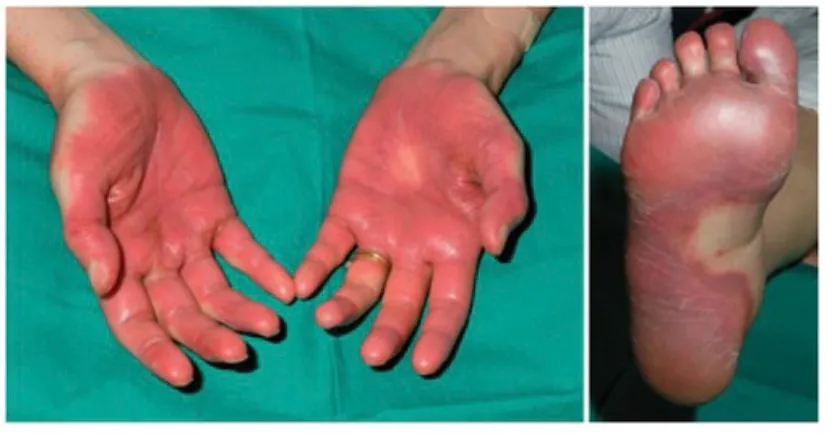
Which of the following anticancer drug causes "Hand and foot syndrome" as a given below image?
- A.
Vincristine
- B.
Vinblastine
- C.
Capecitabine
- D.
Methotrexate
- A.
Q50 · Pharmacology · Drug Affecting Blood & Blood Formation
The Nurse teaches the patient who is receiving warfarin sodium that
- A.
Partial thromboplastin time values determine the dosage of warfarin sodium
- B.
Protamine sulfate is used to reverse the effects of warfarin sodium
- C.
The International Normalized Ratio (INR) is used to assess effectiveness.
- D.
Warfarin sodium will facilitate clotting of the blood.
- A.
- Sign in free
Done 50 questions? Check your answers
Sign in free: every answer with its explanation, attempt the paper timed with negative marking, and track your score.
Q51 · Biochemistry & Nutrition · Immunochemistry
What is the full name of "ELISA"
- A.
Enzyme licensed immune solution activity.
- B.
Enzyme linked immune sorbent assay.
- C.
Enzyme linked integrated solution activity.
- D.
Enzyme linked immune solution assay.
- A.
Q52 · Medical & Surgical Nursing · Gas Exchange and Respiratory Function
Collection of lymph fluid in the pleural space
- A.
Hemothorax
- B.
Pneumothorax
- C.
Chylothorax
- D.
None of the above
- A.
Q53 · Obstetrics & Gynaecology · Diagnosis of Pregnancy
Jacquemier's sign is also known as
- A.
Osiander's sign
- B.
Chadwick's sign
- C.
Goodell's sign
- D.
Hegar's sign
- A.
Q54 · Child Health Nursing (Pediatrics) · Fluid and Electrolyte Disturbances
Which is following common signs of dehydration in children
- A.
Bradycardia
- B.
Hypotension
- C.
Bradypnea
- D.
Dry mucous membranes
- A.
Q55 · Child Health Nursing (Pediatrics) · Common Medical Procedures
Which is most appropriate way to assess pain in an infant
- A.
Numerical pain scale
- B.
FLACC scale
- C.
Visual Analogue scale
- D.
Wong Baker face pain rating scale
- A.
Q56 · Applied Microbiology & Infection control · Miscellaneous
Dengue virus will reduce which type of blood cell
- A.
Neutrophils
- B.
Platelets
- C.
Monocytes
- D.
Eosinophils
- A.
Q57 · Nursing Research & Statistics · Application of Statistics in Health and Uses of Computer in Statistics
Which statistical measure is used to express the number of deaths per 1,000 population
- A.
Crude death rate
- B.
Infant mortality rate
- C.
Maternal mortality rate
- D.
Morbidity rate
- A.
Q58 · Mental Health Nursing · Principles and Concepts of Mental Health Nursing
The acronym "ADLs" in psychiatric nursing stands for
- A.
Activities of daily living
- B.
Assessment of diagnostic levels
- C.
Anxiety and depression levels
- D.
Acute disease limitation
- A.
Q59 · Applied Nutrition & Dietetics · Therapeutic Diet
Which of the following dietary components can help in reducing cholesterol levels
- A.
Saturated fats
- B.
Soluble fibre
- C.
Trans fats
- D.
Refined sugars
- A.
Q60 · Medical & Surgical Nursing · Digestive and Gastrointestinal Function
Which of part of the colon is the preferred site for permanent colostomy
- A.
Ascending colon
- B.
Transverse colon
- C.
Descending colon
- D.
Sigmoid colon
- A.
Q61 · Nursing Foundations · Hospital Admission & Discharge
The assessment method that occurs after the patient has been discharged is
- A.
Concurrent evaluation
- B.
Auditing
- C.
Retrospective evaluation
- D.
Quality assurance
- A.
Q62 · Applied Psychology · Motivation & Emotional Processes
Hierarchy of needs is explained by
- A.
Ivan Pavlov
- B.
Abraham Maslow
- C.
Jean Piaget
- D.
Carl Rogers
- A.
Q63 · Medical & Surgical Nursing · Fluid and Electrolytes: Balance and Distribution
Major electrolyte imbalance that occurs in water intoxication is
- A.
Hypernatremia
- B.
Hyponatremia
- C.
Hypokalemia
- D.
Hyperkalemia
- A.
Q64 · Applied Psychology · Mental Health & mental hygiene
Non directive counselling is also called
- A.
Client centered counselling
- B.
Eclectic counselling
- C.
Integrated counselling
- D.
Suggestive counselling
- A.
Q65 · Applied Sociology · Social structure
What term describes the movement of people from one place to another
- A.
Urbanization
- B.
Migration
- C.
Immigration
- D.
Emigration
- A.
Q66 · Child Health Nursing (Pediatrics) · Disorders of Kidney and Urinary Tract
Which condition is characterized by frequent involuntary urination in child older than 5 years
- A.
Encopresis
- B.
Nocturnal enuresis
- C.
Constipation
- D.
Diarrhoea
- A.
Q67 · Mental Health Nursing · Principles and Concepts of Mental Health Nursing
Standards of mental health practices are Published by
- A.
ANA
- B.
INC
- C.
SNC
- D.
TNAI
- A.
Q68 · Applied Psychology · Psychological assessment & tests
Which one of the following is not an example of Artistic Aptitude Test
- A.
Graphic Arts Test
- B.
Musical aptitude Test
- C.
Literary aptitude Test
- D.
General Aptitude test Battery
- A.
Q69 · Applied Physiology · Sensory organs
Night blindness is caused by
- A.
Central retinal vein occlusion
- B.
Dystrophies of retinal rods
- C.
Dystrophies of the retinal cones
- D.
Retinal detachment
- A.
Q70 · Medical & Surgical Nursing · Neurologic Function
Which of the following is a key sign of increased intracranial pressure (ICP) following a head injury ?
- A.
pupil dilation
- B.
bradycardia
- C.
hypotension
- D.
hyperthermia
- A.
Q71 · Mental Health Nursing · Eating Disorders
Patient with anorexia nervosa will have
- A.
Tachycardia, hypertension, hypothermia
- B.
Bradycardia, hypotension, hypothermia
- C.
Tachycardia, hypotension, hypothermia
- D.
Bradycardia, Hypertension, Hyperthermia
- A.
Q72 · Child Health Nursing (Pediatrics) · Newborn Infants
The best way of feeding a newborn weighing less than 1200 gm on first day of life is
- A.
Breast feeding
- B.
Gavage feeding
- C.
Katori and Spoon
- D.
Bottle-Feeding
- A.
Q73 · Medical & Surgical Nursing · Metabolic and Endocrine Function
A client is getting prednisolone injection as continuous infusion. The important nursing management is
- A.
Hourly urine specific gravity
- B.
Hourly blood sugar
- C.
Hourly abdominal girth
- D.
Hourly head circumference
- A.
Q74 · Nursing Research & Statistics · Application of Statistics in Health and Uses of Computer in Statistics
Full form of SPSS is
- A.
Statistical package for social System
- B.
Statistical Programme for social Sciences
- C.
Statistical Package for Social Sciences
- D.
Statistical Programme for Scientific Studies
- A.
Q75 · Applied Anatomy · Circulatory & Lymphatic System
The coronary arteries arise from which part of aorta
- A.
Ascending Aorta
- B.
Arch of Aorta
- C.
Descending Aorta
- D.
Thoracic Aorta
- A.
- Sign in free
Done 75 questions? Check your answers
Sign in free: every answer with its explanation, attempt the paper timed with negative marking, and track your score.
Q76 · Nursing Management & Leadership · Management of Nursing Service in the Hospital & Community
VED stands for
- A.
Valuable, Essential, Desirable
- B.
Valuable, Estimated, Desirable
- C.
Vital, Essential, Desirable
- D.
Vital, Estimated, Desirable
- A.
Q77 · Pharmacology · Drugs Acting on Central Nervous System
Which of the psychiatric drug does not need any test dose before starting routine dose
- A.
Haloperidol
- B.
Risperidone
- C.
Clozapine
- D.
Quetiapine
- A.
Q78 · Pharmacology · Hormones & Related Drugs
Identify the emergency contraceptive among the following
- A.
Prostaglandin
- B.
Progesterone only
- C.
Mala-D
- D.
Levonorgestrel
- A.
Q79 · Applied Microbiology & Infection control · Miscellaneous
Which of the following immunoglobulins is first produced during acute infection
- A.
IgG
- B.
IgE
- C.
IgM
- D.
IgD
- A.
Q80 · Obstetrics & Gynaecology · COMPLICATED LABOR-Malposition, Malpresentation and Cord Prolapse
Engaging diameter of face presentation is
- A.
Mentobregmatic
- B.
Submentobregmatic
- C.
Mentovertical
- D.
Submentovertical
- A.
Q81 · Nursing Foundations · Hygiene
Which of the following terms is used to document a bluish discolouration of the skin
- A.
Erythema
- B.
Jaundice
- C.
Cyanosis
- D.
Pallor
- A.
Q82 · Pharmacology · Drugs Acting on Central Nervous System
Atropine is commonly used prior to administration of inhalant anaesthetics to reduce
- A.
Muscle tone
- B.
Secretions
- C.
Nausea and vomiting
- D.
Heart rate
- A.
Q83 · Community Health Nursing · National Health Programs
Which health unit change into health and wellness center
- A.
Subcenter
- B.
Community health center
- C.
Primary health center
- D.
Civil hospital
- A.
Q84 · Medical & Surgical Nursing · Urinary Tract Function
Bonney's test is used to confirm
- A.
Stress incontinence
- B.
Urge incontinence
- C.
Overflow incontinence
- D.
Neurogenic incontinence
- A.
Q85 · Mental Health Nursing · Mood disorders
Which is most appropriate nursing action for a 32 years female patient diagnosed with bipolar affective disorder
- A.
Use physical restraints
- B.
Established clear boundaries
- C.
Use chemical restraints
- D.
Give ECT
- A.
Q86 · Medical & Surgical Nursing · Urinary Tract Function
Hydronephrosis is the
- A.
Infection of renal pelvis
- B.
Distension of renal pelvis
- C.
Presence of water in renal pelvis
- D.
Contraction of renal pelvis
- A.
Q87 · Applied Nutrition & Dietetics · Minerals
Which mineral is crucial for the formation of haemoglobin
- A.
Zinc
- B.
Calcium
- C.
Magnesium
- D.
Iron
- A.
Q88 · Applied Psychology · Soft Skills & its applications
In the context of a sender’s message, what is the response received called?
- A.
Answer
- B.
Feedback
- C.
Food bank
- D.
Encoding
- A.
Q89 · Applied Nutrition & Dietetics · Vitamins
Which Vitamin deficiency will cause Beriberi disease/Disorder
- A.
Vitamin B12
- B.
Vitamin B2
- C.
Vitamin B1
- D.
Vitamin B3
- A.
Q90 · Forensic Nursing & Indian laws · Miscellaneous
Hospital has to keep MLC record up to
- A.
1 years
- B.
5 years
- C.
15 years
- D.
10 years
- A.
Q91 · Child Health Nursing (Pediatrics) · Disorders of Respiratory System
Which condition is commonly associated with poor weight gain and frequent respiratory infection in infants
- A.
Cystic fibrosis
- B.
Asthma
- C.
Congenital heart disease
- D.
Iron deficiency anaemia
- A.
Q92 · Obstetrics & Gynaecology · Complicated Pregnancy
Delayed cord clamping is contraindicated in
- A.
Baby born to anaemic mother
- B.
Baby with birth weight less than 3kg
- C.
Rh-incompatibility
- D.
Preterm baby
- A.
Q93 · Community Health Nursing · Respiratory Infections
An outbreak of disease in a bird population is
- A.
Ornithology
- B.
Epornithic
- C.
Oncology
- D.
None of these
- A.
Q94 · Community Health Nursing · Epidemiology – Epidemiological Approaches and Processes
Recommended temperature of storage of Polio vaccine is
- A.
36 degree C
- B.
-20 degree C
- C.
-4 degree C
- D.
30 degree C
- A.
Q95 · Medical & Surgical Nursing · Metabolic and Endocrine Function
Before having blood test of T4, the patient should be informed that
- A.
Thyroid medication must be stopped
- B.
Fasting is not necessary
- C.
A concurrent 24-hour urine is collected
- D.
Multiple venipunctures are required
- A.
Q96 · Medical & Surgical Nursing · Sensorineural Function
The examination of the angle of the anterior chamber of the eye with a magnifying device known as
- A.
Ophthalmoscopy
- B.
Otoscope
- C.
Gonioscopy
- D.
Probe
- A.
Q97 · Medical & Surgical Nursing · Miscellaneous
Excess collection of fluid in peritoneal cavity is known as
- A.
Anasarca
- B.
Ascites
- C.
Pleural effusion
- D.
Pedal Edema
- A.
Q98 · Medical & Surgical Nursing · Neurologic Function
Which of the following score indicates coma in an adult patient as per GCS
- A.
0
- B.
12
- C.
9
- D.
5
- A.
Q99 · Community Health Nursing · Health Care Planning and Organization of Health Care at various levels
The multipurpose health worker concept is given by
- A.
Bhore committee
- B.
Srivastava committee
- C.
Kartar Singh Committee
- D.
Mudaliar committee
- A.
Q100 · Applied Nutrition & Dietetics · Balanced Diet
What is the recommended daily intake of fibre for adults
- A.
10-15 grams
- B.
25-30 grams
- C.
35-40 grams
- D.
45-50 grams
- A.
- Sign in free
Done 100 questions? Check your answers
Sign in free: every answer with its explanation, attempt the paper timed with negative marking, and track your score.
Q101 · Community Health Nursing · Epidemiology – Epidemiological Approaches and Processes
Which epidemiological study design is used to investigate disease outbreaks
- A.
Cohort study
- B.
Case-control study
- C.
Cross-sectional study
- D.
Descriptive study
- A.
Q102 · Applied Physiology · Endocrine system
Which hormone is released from zona glomerulosa
- A.
Oestrogen
- B.
Aldosterone
- C.
Adrenalin
- D.
Cortisol
- A.
Q103 · Mental Health Nursing · Schizophrenia
A client tells the Nurse that the TV newscaster is sending secret message to her. The nurse suspects the client experiencing
- A.
Flight of Ideas
- B.
Idea of reference
- C.
Phobia
- D.
Hallucination
- A.
Q104 · Nursing Foundations · History of Nursing & Nursing as a profession
A patient who decides to leave the hospital against medical advice (LAMA) must sign a form. What is the purpose of this form
- A.
To release the physician and hospital from legal responsibility for the patient's health status
- B.
To ethically illustrate that the patient has control of his or her own care and treatment
- C.
To use in the event of readmission
- D.
To indicate the patient's wishes.
- A.
Q105 · Applied Microbiology & Infection control · General Characteristics of Microbes
Which characteristic is commonly used to classify bacteria
- A.
Ability to photosynthesize
- B.
Presence of a nucleus
- C.
Shape and arrangement
- D.
Size in micro meters
- A.
Q106 · Obstetrics & Gynaecology · COMPLICATED LABOR-Malposition, Malpresentation and Cord Prolapse
The safest position for a lady with cord prolapsed in labor is
- A.
Fowler's position
- B.
Prone
- C.
Supine
- D.
Trendelenburg
- A.
Q107 · Medical & Surgical Nursing · Miscellaneous
What is the recommended ratio of chest compressions to rescue breaths in adult CPR according to American heart association (AHA)
- A.
15:2
- B.
30:2
- C.
15:1
- D.
5:1
- A.
Q108 · Biochemistry & Nutrition · Lipids
In a person on hunger strike from past three days which of the following urinary tests would give a positive reaction?
- A.
Benedict's
- B.
Barfoed's test
- C.
Rothera's
- D.
Biuret
- A.
Q109 · Applied Microbiology & Infection control · Miscellaneous
Which of the following is considered a key element of the chain of infection
- A.
Vaccination
- B.
Antibiotic resistance
- C.
Personal protective equipment (PPE)
- D.
Reservoir
- A.
Q110 · Medical & Surgical Nursing · Fluid and Electrolytes: Balance and Distribution
Capnography is a measurement of
- A.
CO2 concentration
- B.
H ion concentration
- C.
Bicarbonate concentration.
- D.
Anion gap
- A.
Q111 · Nursing Research & Statistics · Research Problem/Question
Feasibility of a research study is determined by examining
- A.
Investigator's credibility
- B.
Availability of Subjects
- C.
Importance of research
- D.
Previous research evidences
- A.
Q112 · Applied Psychology · Cognitive Process
The gestalt principle of continuity refers to our tendency to perceive
- A.
Figures rather than ground
- B.
Elements that move together as belonging together
- C.
Objects in groups when they are similar
- D.
A series of points or lines as having unity
- A.
Q113 · Applied Physiology · Endocrine system
Which hormone is secreted by adrenal medulla & is involved in fight & flight response
- A.
Cortisol
- B.
Epinephrine
- C.
Aldosterone
- D.
Insulin
- A.
Q114 · Child Health Nursing (Pediatrics) · Immunization and Immunodeficiency
The vaccine given at the age of 5 years is
- A.
DPT- 1st dose
- B.
DPT-2nd Dose
- C.
DT
- D.
DPT-3rd Dose
- A.
Q115 · Medical & Surgical Nursing · Integumentary Function
The newly admitted client has burns on both legs. The burned areas appear white and leather-like. No blisters or bleeding are present, and the client states that he or she has little pain. How should this injury be categorized
- A.
Superficial
- B.
Partial-thickness superficial
- C.
Partial-thickness deep
- D.
Full thickness
- A.
Q116 · Medical & Surgical Nursing · Miscellaneous
Adventitious breath sounds include all of the following except
- A.
Crackles
- B.
Bronchovesicular sounds
- C.
Wheezing
- D.
Rhonchi
- A.
Q117 · Nursing Foundations · Nursing Theories
The Theory that involves care and helps through which the client attains total self-care is
- A.
Nightingale theory
- B.
Orem's theory
- C.
Peplau's theory
- D.
Roy's theory
- A.
Q118 · Pharmacology · General Pharmacology
What is the preferred route of iron dextran administration
- A.
IM Z-track
- B.
Intra venous
- C.
Intra arterial
- D.
Intra osseous
- A.
Q119 · Nursing Education · Implementation
Which of the following is a Socratic method of teaching
- A.
Lecture
- B.
Film
- C.
Exhibition
- D.
Panel Discussion
- A.
Q120 · Applied Physiology · General Physiology
The primary source of heat in the body is
- A.
Sunlight
- B.
Metabolism
- C.
Heart beat
- D.
Circulation
- A.
More RUHS M.Sc Nursing Entrance papers
- RUHS Jaipur M.Sc Nursing Entrance 20232023 · 120 questions
- RUHS Jaipur M.Sc Nursing Entrance 20222022 · 120 questions
- RUHS Jaipur M.Sc Nursing Entrance 20212021 · 120 questions
- RUHS Jaipur M.Sc Nursing Entrance 20192019 · 120 questions
- RUHS Jaipur M.Sc Nursing Entrance 20182018 · 120 questions
- RUHS Jaipur M.Sc Nursing Entrance 20162016 · 120 questions
- RUHS Jaipur M.Sc Nursing Entrance 20152015 · 120 questions