Nursing Foundations · Comfort, Rest & Sleep & Pain

Comfort, Rest & Sleep & Pain

Sims positiondefinition

A side-lying posture, usually left lateral, with the patient on the left side and the right knee drawn up towards the chest.

in simple words: Left side-lying with right knee flexed.

e.g. Standard for administering an enema.

Why left Sims for enema?

The sigmoid colon lies on the left, so gravity carries the solution along its natural curve, improving retention and effectiveness. High yield

Alternative positions

  • Right lateral – If patient cannot lie on left side (e.g., left hip fracture, respiratory distress); less effective.
  • Knee-chest – Another option but hard for ill/elderly to maintain.
© NextNurse

nextnurse.in

Comfort, Rest & Sleep & Pain · Nursing Foundations

Respiratory Positions

Fowler's positiondefinition

Head-of-bed elevation of 45–60 degrees; semi-sitting position used for respiratory or cardiovascular conditions.

in simple words: Sitting up at 45–60°.

High-Fowler's for dyspnea

High-Fowler's (60–90°) is the best position to relieve dyspnea: gravity pulls the diaphragm down, allowing maximum chest expansion and reducing work of breathing. High yield

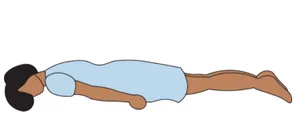
Patient lying face down in prone position to improve oxygenation.
Prone position

Orthopneic (tripod) positiondefinition

Sitting at the side of the bed leaning forward over an overbed table with pillows.

in simple words: Leaning forward to use accessory muscles.

Why tripod helps

Leaning forward fixes the shoulder girdle so accessory muscles lift the chest wall, increasing anteroposterior diameter and reducing work of breathing. It is an instinctive posture in severe distress signalling need for immediate intervention.

© NextNurse

nextnurse.in

Comfort, Rest & Sleep & Pain · Nursing Foundations

Positioning Devices

Why positioning devices?

They maintain alignment, prevent contractures, and protect skin. High-Fowler's (60–90°) creates the greatest shearing force, especially over sacrum and heels — limit head elevation above 30° unless contraindicated.

Common devices

DevicePurpose
Trochanter rollPrevents external rotation of hips
Hand rollMaintains functional position of fingers/thumb
Trapeze barHelps lift upper body; does not prevent hip rotation
Abduction pillowAfter hip replacement: prevents adduction/rotation
Bed cradleKeeps linens off skin (burns, ulcers, fractures)
Foot boardHolds feet in neutral dorsiflexion (90°); contraindicated with heel pressure injury

© NextNurse

nextnurse.in

Comfort, Rest & Sleep & Pain · Nursing Foundations

Sleep Hygiene

Promoting sleep

Non-pharmacological measures are first-line. Slow, calming music lowers heart rate and stress, easing sleep onset. Avoid caffeine (blocks adenosine receptors) and late heavy meals.

Key sleep hygiene points

  • Exercise – Avoid within 2–3 hours of bedtime (raises core temperature, heart rate, adrenaline).
  • Fluids – Decrease 2–4 hours before sleep to reduce nocturia in older adults.
  • Naps – Long or late-day naps reduce homeostatic sleep drive.
  • Routine – Consistent wake-up time supports circadian rhythm; sleeping in disrupts it.

© NextNurse

nextnurse.in

Comfort, Rest & Sleep & Pain · Nursing Foundations

Pain Types

Acute paindefinition

Protective, temporary, self-limiting; resolves with tissue healing. Rapid onset, triggers autonomic responses (↑HR, ↑BP).

in simple words: Short-term, goes away with healing.

Chronic paindefinition

Lasts beyond normal healing period, typically >3–6 months. Persistent, not self-limiting; requires multidisciplinary approach.

in simple words: Long-term pain lasting months.

Nociceptive paindefinition

Caused by activation of pain receptors due to actual or potential tissue damage. Can be acute or chronic.

in simple words: Pain from tissue damage.

Referred paindefinition

Perceived at a location different from its source (e.g., myocardial infarction → left shoulder/arm).

Phantom paindefinition

Felt in a body part that has been amputated or is no longer present.

© NextNurse

nextnurse.in

Comfort, Rest & Sleep & Pain · Nursing Foundations

Pain Assessment

FLACC scaledefinition

Face, Legs, Activity, Cry, Consolability. Behavioral tool for infants/young children; each scored 0–2, total out of 10.

in simple words: Pain scale for non-verbal children.

Visual Analogue Scale (VAS)definition

10 cm line anchored by 'no pain' and 'worst imaginable pain'; patient marks level.

in simple words: Line scale for pain intensity.

Wong-Baker FACESdefinition

Six cartoon faces from 'No Hurt' (0) to 'Hurts Worst'; for ages 3+ including non-verbal adults.

in simple words: Faces scale for pain.

Behavioral Pain Scale

Assesses pain in patients who cannot communicate verbally (sedated/intubated) using facial expressions, body movements, and muscle tension.

© NextNurse

nextnurse.in

Comfort, Rest & Sleep & Pain · Nursing Foundations

Heat & Cold Therapy

Physiological effects

Heat causes vasodilation (↑blood flow, hyperemia); cold causes vasoconstriction (↓blood flow, numbs nerve endings).

Indications & contraindications

TherapyIndicationsContraindications
HeatClosed muscle spasmsAcute injury <48h, active bleeding, malignancy, open wounds
ColdAcute injury to stop bleeding, reduce swellingRaynaud's phenomenon, severe peripheral vascular disease

© NextNurse · Checked against: NextNurse Q-Bank explanations

nextnurse.in