Nursing Foundations · Patient Education

Patient Education

Learning domains (Bloom's Taxonomy)definition

Cognitive, affective and psychomotor are the three formal domains of learning.

in simple words: Thinking, feeling and doing.

Cognitive – thinking, knowledge, understanding

  • Attention is a cognitive function needed for all learning, not a separate domain.

Affective – feelings, attitudes, values, beliefs

  • Motivation or fear about using a walker belongs here, but the physical act of using it does not.

Psychomotor – physical or motor skills

  • Learning to use a walker, balance, step and move requires coordinated brain, nerve and muscle action.
  • Teaching uses nurse demonstration, practice and return demonstration.

Three domains
© NextNurse

nextnurse.in

Patient Education · Nursing Foundations

Nurse's Teaching Role

Why patient education matters

Patient teaching takes place mainly in the working phase of the nurse-patient relationship. In Peplau's theory the working phase is the active problem-solving stage where the nurse provides information and skills for self-care. The orientation phase focuses on building trust, assessing the patient and setting goals; extensive complex teaching here can overwhelm the patient because rapport is not yet established. The termination phase is for evaluating outcomes and concluding the relationship.

Nursing roles in patient education

  • Educator – Explains concepts, demonstrates procedures, reinforces learning, and evaluates patient progress. Teaching is a core nursing role that promotes self-management and independence, especially for chronic conditions like diabetes.
  • Advocate – Protects the client's human and legal rights, acting on the client's behalf to uphold autonomy and self-determination, including during informed consent and when reporting unsafe or unethical practice.
  • Change agent – Implements new approaches to problems at the agency or community level, not individual patient teaching.
  • Case manager – Coordinates resources and services for a patient's care across the healthcare continuum, not direct teaching.

© NextNurse

nextnurse.in

Patient Education · Nursing Foundations

Barriers to Learning

Readiness to learn

Visitors, anxiety and emotional distress are barriers that reduce a patient's readiness to learn. Distraction and stress impair concentration, so assess physical comfort, emotional state and alertness before starting any teaching session. Pain is a barrier to learning, so teach a patient when pain medication is working. If the analgesic makes the patient drowsy, postpone teaching to a time when the patient is both comfortable and alert.

Other barriers

  • Cognitive overload – Giving too much information in a short period causes cognitive overload and poor retention. Patients can process only a limited amount of new information at one time, so teaching should be paced.
  • Passive methods – Relying only on written materials or media is a passive method that fails to assess comprehension. A single passive method does not address diverse learning styles and health literacy levels.
  • Complex information – Providing complex medical information without simplification leads to misunderstanding and non-adherence. Health literacy is a major barrier; information must be clear, simple, and tailored to the learner.

© NextNurse

nextnurse.in

Patient Education · Nursing Foundations

Teaching Methods

Matching method to domain

Lecture, discussion, seminar, symposium and brochures teach knowledge but cannot replace supervised practice of a physical skill. Lecture and symposium suit cognitive learning; discussion suits the affective domain; brochures only reinforce information. None allow the hands-on practice a motor skill needs.

Method vs domain

MethodBest forLimitation
Lecture / symposiumCognitiveNo hands-on practice
DiscussionAffectiveLimited skill building
BrochuresReinforcementNo comprehension check
Demonstration + return demonstrationPsychomotorTime and supervision needed

© NextNurse

nextnurse.in

Patient Education · Nursing Foundations

First Aid: Bleeding

First aiddefinition

Immediate help given to a victim at the accident site until professional medical care is available.

in simple words: Simple, life-saving techniques with minimal equipment.

Bleeding control sequence

  1. Direct pressureApply firm direct pressure over the wound with a clean or sterile dressing as the first action.
  2. ElevationRaise the injured area above heart level to slow bleeding.
  3. Pressure pointApply pressure to pressure points only if direct pressure fails.
  4. TourniquetLast resort for life-threatening extremity bleeding, applied 2-3 inches proximal to the wound, avoiding joints.

© NextNurse

nextnurse.in

Patient Education · Nursing Foundations

Choking and Drowning

Choking

A choking person who can still cough or speak has a mild obstruction; encourage coughing and do not interfere. Signs of severe obstruction are inability to speak, cough or breathe, and clutching the throat. For a conscious person with severe choking, give five sharp back blows between the shoulder blades first. Lean the person forward so a dislodged object exits the mouth rather than moving deeper. If back blows fail, give five abdominal thrusts (Heimlich manoeuvre).

Drowning

In drowning, the primary injury is hypoxia, so restoring oxygenation is the priority. After rescuing a drowning victim, the first step is to assess responsiveness by shouting and tapping. Turn the face sideways to drain water and secretions from the airway. Do not offer fluids orally. All drowning victims require hospital evaluation even if they appear recovered, due to risk of secondary drowning.

© NextNurse

nextnurse.in

Patient Education · Nursing Foundations

Burns and Bites

Chemical burns

For a liquid chemical spill on the skin, immediately irrigate with copious water for at least 15–20 minutes. For dry chemical powder on the skin, brush off the powder before flushing with water. For a chemical burn in the eye, immediately rinse the affected eye with running water or normal saline. Do not apply ointment or cover a chemical eye injury before irrigation.

Animal bites

Immediate first aid for a dog bite is thorough washing of the wound with soap and running water for at least 15 minutes. Antiseptics such as povidone-iodine or chlorhexidine are applied only after the wound has been washed. Primary suturing of a dog bite wound is contraindicated because it traps anaerobic bacteria and rabies virus. All animal bites must be reported to local public health authorities.

© NextNurse

nextnurse.in

Patient Education · Nursing Foundations

Electric Shock and CPR

Electric shock

  1. Switch off powerFirst action is to switch off the power supply to ensure rescuer safety.
  2. Separate victimIf power cannot be switched off, use a non-conductive object such as a dry wooden stick or rubber mat.
  3. Assess and CPROnly after the power is off can the rescuer assess the victim and begin CPR if needed.

CPR sequence

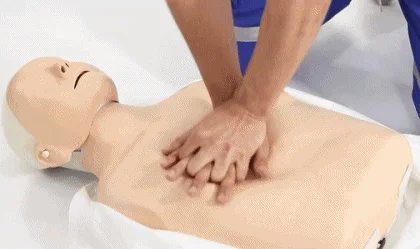
In adult CPR, chest compressions are started before airway and breathing (C-A-B). Compressions are begun only after scene safety is confirmed and the casualty is unresponsive with no normal breathing. The head-tilt-chin-lift is the standard airway maneuver in most CPR situations, used when cervical spine injury is not suspected. If spinal injury is suspected, open the airway with a jaw-thrust maneuver while keeping the head, neck, and spine in neutral alignment.

A rescuer performing chest compressions on an adult in cardiac arrest.
Adult CPR chest compressions

Image: Video by Bangkok Hospital Phuket Segment extracted and converted by Mikael Häggs, CC BY 3.0

© NextNurse

nextnurse.in

Patient Education · Nursing Foundations

Recovery Position and Fainting

Recovery position

An unconscious but breathing person should be placed in the recovery position to maintain a clear airway. The lateral side-lying position uses gravity to prevent the tongue from falling back and allows vomit or fluids to drain out, preventing aspiration.

Fainting (syncope)

Fainting is a temporary loss of consciousness from reduced blood flow to the brain. Most episodes are vasovagal and benign, but syncope can signal cardiac arrhythmia, structural heart disease or a neurological problem, so the cause must be investigated. For a person who has fainted, lay them flat and elevate the legs above heart level. Raising the head or standing the person worsens cerebral perfusion.

© NextNurse

nextnurse.in

Patient Education · Nursing Foundations

Nosebleed and Eye Injury

Nosebleed (epistaxis)

Kiesselbach's plexus, in the anterior nasal septum, is the most common site of epistaxis. For a nosebleed, sit the person upright, lean the head forward, and pinch the soft part of the nose. Leaning forward prevents blood from draining into the throat; pinching compresses the bleeding vessels. Tilting the head back during a nosebleed can cause blood to drain into the throat, leading to choking or aspiration.

Eye foreign body

For a loose eyelash in the eye, flush with clean water or normal saline for 10-15 minutes, irrigating from the inner canthus outwards. Irrigating from the nose outwards prevents washing the object into the tear duct or contaminating the other eye. Using a swab or cloth to remove a loose eyelash risks corneal abrasion and infection. For a penetrating eye injury, cover the eye and transport immediately to a healthcare facility.

© NextNurse

nextnurse.in

Patient Education · Nursing Foundations

First Aid Kit and Aims

Basic first aid kit

  • Adhesive bandages – Essential for covering minor cuts and scrapes. They protect wounds from dirt and bacteria, help prevent infection and apply gentle pressure to control minor bleeding.
  • Not included – A stethoscope, syringe and thermometer are not essential items. A stethoscope is a diagnostic tool, a syringe is used for injections or wound irrigation, and a thermometer is not needed for managing acute injuries like cuts or sprains.

Three core aims of first aid

The three core aims of first aid are preserve life, prevent worsening, and promote recovery. Preventing infection is a secondary objective, not one of the three core aims. Relieving pain is part of promoting recovery in first aid. Pain relief is secondary to preserving life and preventing further harm.

© NextNurse · Checked against: NextNurse Q-Bank explanations

nextnurse.in